If it be possible, as much as in you lieth, be at peace with all men. (Romans 12:18 RV)
Good-by, my friends. Do better and pay attention to what I have said. Try to get along and live peacefully with each other. Now I pray that God, who gives love and peace, will be with you. (2 Cor 13:11 CEV)
giving diligence to keep the unity of the Spirit in the bond of peace. (Eph 4:3 RV)
Try to live at peace with everyone! Live a clean life. If you don't, you will never see the Lord. (Hebrews 12:14 CEV)
Some organizations and religious bodies demand unity and peace beyond all else. Put up and shut up. Don't make any waves. Endure your imperfect brothers for the sake of unity. But is this the Christian way? How did the early Christians resolve disputes? Did they tolerate imperfection in their brothers?
JESUS INSTRUCTS, DON'T LET OFFENCES FESTER
Note that he tells the offended party to go directly to the source and work it out.
(Matthew 5:21-24)
The pattern is as follows.
1. Go directly to your brother to work it out.
2. If that doesn't work, talk about it with some witnesses present.
3. If that doesn't work, bring it before the congregation.
(Matthew 18:15-17)
Where in the following two examples are the elders as intermediaries? Closed door meetings? Private reproof? It is clear that disputes are to be handled in public, so that no-one can question the wisdom of the decision.
GREEK WIDOWS
I think the first big dispute came over the treatment of widows. (Acts 6).
Did the widows keep silent and "wait on Jehovah"? No!
Here's the pattern of dispute resolution I see here:
1. Widows complain.
2. The twelve called everyone together and suggested that someone be assigned to take care of it.
3. The multitude agreed, and the problem was resolved to everyone's satisfaction.
Fairly open and democratic, wouldn't you say? The widows were not obliged to wait until Jehovah noticed their plight.
SAUL and the DISCIPLES
The disciples weren't sure how to take the dramatic conversion of Saul. (Acts 9).
Did Barnabas keep silent in the face of the apostle's skepticism, in order to keep the unity? Did he "wait on Jehovah" for them to see the light? No.
Barnabas brought Paul before the apostles and described to them all that he had seen Paul do, and how he had put his life in danger for the gospel. The apostles then accepted Paul.
Barnabas spoke up for an honorable man.
PAUL EXHORTS THE CORINTHIANS
He goes on a delightful rant to the Corinthian church to work out minor disputes amongst themselves (1 Corinthians 6).
SUMMARY
Now remember, this is the early church, where the Holy Spirit was in daily evidence, and they worked togehter "with one accord" (Acts 2:46). The Christians would never be in as much unity as those early days. Nevertheless, they had disputes. They aired their concerns, and they found their way.
From these examples, the bible pattern is pretty clear. Air your feelings. Don't bury it, don't hide it, and don't pretend it's not a problem. Get it out in the open, and deal with it. And for God's sake, don't wait for Jehovah to take care of it.
Friday, January 16, 2009
Thursday, January 15, 2009
Devotion makes me cry
It was a book that brought me to tears. It was the story of a young man who gave his all to good. That will get me every time. The story was from Navy commander Abrashoff and his relationship with the crew of the USS Benfold. He listened to them and helped them do their job better. Along the way, there were stories of nobility. These young men joined the navy to escape or rise from a checquered past. Some chose to make a better way. Like the young man who had spent his childhood bouncing from one foster home to another, who resolved to be a social worker. He would make a difference for the young boys coming after him.
That example of selfless giving always moves me to tears. It speaks to greater values than personal gain. It is still there in our society, maybe not blazing in neon or blaring from our i-pods or speakers, but it is there.
That example of selfless giving always moves me to tears. It speaks to greater values than personal gain. It is still there in our society, maybe not blazing in neon or blaring from our i-pods or speakers, but it is there.


Wednesday, January 14, 2009
Rethinking Silence
I might have to re-think my stance on silence. My church had a themed message on prayer and the power of hearing God in the silence. I, of course, raced through my to-do list in the quietness, preparing, planning, scheming for the coming week.
Perhaps I am wired too tight.
Anyways, afterwards the church encouraged us all to tour a fantastic interactive display to have us sit, meditate, and think. Most impressive was a blacklight tent highlighting the seven hebrew words for praise.
To bad I had to rush through it. I would have loved to have an hour to stop and meditate on each word.
Here's a link that speaks more of the seven words.
http://home.earthlink.net/~anointed.word/burton.htm
There's:
YADAH - hands to God
TOWDAH - speak the same thing (integrity?)
SHABACH - joyful and loud adoration (sports stadium enthusiasm!)
BARAUCH - kneel before God
ZAMAR - sing
HALAH - rave and be clamourously foolish (children shrieking in play comes to mind. How often do we cut loose like that?)
TEHILLAH - sing publiclly (I think)
Is it any coincidence that I was given a tortuous night of silence, and a few moments to reflect on it's significance, just before my church covered the same theme? A comforting thought is many of these praise themes are loud and raucous.
Sunday, January 11, 2009
In the head of your opponents
I'm happy to say I've now lived long enough to confirm that revenge is a waste. Not that I've acted out on many, but my past tormenters provided me opportunity to come up with delicious plans for revenge. Though those thoughts were a comfort in their own way, I'm embarrassed I indulged in them now. Revenge is a waste.
Why? Because now I've seen the end for the cruel.
One of my chief defences against my opponents has been to get inside their head. If I understood their behavior and what made them tick, I could structure our relationship so that they could no longer harm me. I avoided situations that would lead us in to conflict. For every one of their actions, I had a planned reaction. The strategy has worked very well. An unpleasant side-effect is that I've had to come to understand, even empathize, with people with very different motives than I. The picture is not pretty.
I'd say one common characteristic of brutal or cruel people is that they lack a basic self-awareness. They don't know why they do what they do. Their reactions are reflexive and they will repeat their behavior, bull-headed, even when it harms them. They may gain temporary promotion or success, but eventually that blind spot stops them cold. Not only that, they don't have the self awareness or the tools to recognize what is wrong or get past the obstacle. Life becomes a puzzling affair of blind alleys and false starts.
Now I am sorry I indulged in thoughts of revenge. My chief feeling today is of pity. They are trapped in the cage of their own making, with no way of finding their way out.
Saturday, January 10, 2009
Silence
Last night the house was silent. It was silent and I could not sleep. As I lay there staring at the ceiling, I flashed back to nights ten years past, the last time I was captive in a silent house, alone in the dark, save the familiar creaks and groans of a mature home settling in for the night. I did not like it then, and I was brutally reminded last night that I still don't like it.
I'd surely fail at hermit school.
Last night was a rare occurrence where hubby was out for the evening and cable was out. I was alone with the silences and my book.
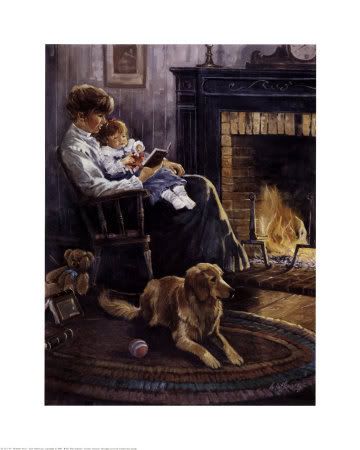
My habit is to fall asleep with the television on. Terrible, I know, to let the TV in to the bedroom. But it does not keep me from sleeping. I turn off like a switch promptly at ten, reduced to a sleepy bundle of mumbles. Hubby is solicitous, asking if the television is too loud. I murmer that it is fine. He then happily turns to whatever channel I might not approve. I like the background noise, obviously. That powerfully came home to me last night.
In the evening also hubby is a constant source of chatter. He may talk about the car we might buy next, the pop culture topic he is obsessing over, when we shall do dishes next, on the state of our neighbours, the oddity of our relatives, when we might visit our friends again, what we shall have for dinner or where we go out next, or any of dozens of cares and interests that fill our days. Many days I only half listen, a book open in front of me, my replies reduced to hums and uh huhs. It comes to me that his chatter is a welcome white noise to cover the silence.
It was the horror of silence, ten years ago, that spurred me to join a dating service that led me to my hubby. In all my life, I've only lived alone those two short years, and I hated it. I'd gone straight from home to teen parent, and for the next twenty years, I worked on raising my children and growing up myself. But it was a great time, full of industry and life. I love the background noise of family.
I wondered last night, as I stared at the ceiling, in my abhorrence of silence, am I hiding from my own inner thoughts? I don't think so. I have a rich internal life, which hubby, exhasperated, persistently draws me out, "Hellooooo, are you listening?" I take the time to reflect, and to write down those deep reflections here. I don't think I am hiding from myself.
I do fear, though, that introspection alone is it's own danger. Perhaps I fear, in the deep silence, I might withdraw completely from the active, cheering, distracting clamour of daily life. There is a simple joy in just living. I don't want to forget that.
I borrow the cosy picture from Fredy's blog:
http://profile.myspace.com/index.cfm?fuseaction=user.viewprofile&friendID=293448132
I'd surely fail at hermit school.
Last night was a rare occurrence where hubby was out for the evening and cable was out. I was alone with the silences and my book.
My habit is to fall asleep with the television on. Terrible, I know, to let the TV in to the bedroom. But it does not keep me from sleeping. I turn off like a switch promptly at ten, reduced to a sleepy bundle of mumbles. Hubby is solicitous, asking if the television is too loud. I murmer that it is fine. He then happily turns to whatever channel I might not approve. I like the background noise, obviously. That powerfully came home to me last night.
In the evening also hubby is a constant source of chatter. He may talk about the car we might buy next, the pop culture topic he is obsessing over, when we shall do dishes next, on the state of our neighbours, the oddity of our relatives, when we might visit our friends again, what we shall have for dinner or where we go out next, or any of dozens of cares and interests that fill our days. Many days I only half listen, a book open in front of me, my replies reduced to hums and uh huhs. It comes to me that his chatter is a welcome white noise to cover the silence.
It was the horror of silence, ten years ago, that spurred me to join a dating service that led me to my hubby. In all my life, I've only lived alone those two short years, and I hated it. I'd gone straight from home to teen parent, and for the next twenty years, I worked on raising my children and growing up myself. But it was a great time, full of industry and life. I love the background noise of family.
I wondered last night, as I stared at the ceiling, in my abhorrence of silence, am I hiding from my own inner thoughts? I don't think so. I have a rich internal life, which hubby, exhasperated, persistently draws me out, "Hellooooo, are you listening?" I take the time to reflect, and to write down those deep reflections here. I don't think I am hiding from myself.
I do fear, though, that introspection alone is it's own danger. Perhaps I fear, in the deep silence, I might withdraw completely from the active, cheering, distracting clamour of daily life. There is a simple joy in just living. I don't want to forget that.
I borrow the cosy picture from Fredy's blog:
http://profile.myspace.com/index.cfm?fuseaction=user.viewprofile&friendID=293448132
Thursday, January 1, 2009
A Case of Excessive Courtesy
A reader of my blog asked me how I manage to accomplish so much. I gave her a list of reasons why I've ended up the way I am. Not all of the reasons or noble or pretty. There has to be an element of obsessiveness for me to do all that I do. I do so many things well, and I do so much, something has just got to give. My hubby would cheerfully give you a long list of my defects. Perhaps the quirkiest is my inability to keep track of simple things. I lose keys, credit cards, change purse, pens, lip balm, and mitts. Hubby says I'd lose my head if it wasn't screwed on tight.

I got caught out yesterday in a moment of absent-mindedness. The incident and the recovery is an example I think, of the Canadian habit of excessive courtesy. I have a theory, too, on why we do it.
I plan to go to the YMCA to work out after we are let out early on New Year's Eve. I've had an exciting week of physical activity, shifting files, and I am eager to keep the momentum going. I hop over from my secondary office to my primary to pick up my gym bag. The YMCA is right across the street from there. I open up the bag, and there are no gym shoes. Drat. I'd left them at home. Anyways, I go for my swim. Still burning with excess desire, I decide to finish off with twenty minutes on the recumbent cycle. I've cycled at home in my socks before. No harm, right? Did I mention I am wearing thick, day-glo orange socks?
I love thick socks. They cured me of a heel spur years ago, and I won't give them up. These socks are old and chunky, losing their elasticity. They were a poor choice this morning, as they bunched up in my shoes as I shifted files. I'd ended up taking off my shoes on the job so I wouldn't be walking on bunched-up cotton. Perhaps this old chunky pair are due for the dumpster.
Anyways, I am padding through the exercise room in my day-glo chunky old cotton socks. I reach the recumbent cycle at the end of the row, and I am pounced upon by one of the staff. "Excuse me", as he glances nervously at my feet, "Do you have gym shoes?"
I am mortified.
"I am so sorry. I thought I had them with me but I don't. Would it be all right if I went on the machine anyways?"
We jumble our apologies and our reasons together in a rush,
"Maybe this once."
"I won't forget my shoes again."
"You can't go over to the weight area."
"Of course."
"And the treadmill. I hate to think what would happen if you had an accident on the treadmill."
"I won't be going on the treadmill today."
"I'd hate to be responsible...just this once."
"I'm sorry to put you through this. I will be sure to bring my shoes from now on."
We agree I can have my twenty minutes on the cycle machine.
There was such a complex interaction of empathy and a desire to please in that short exchange. Neither of us wanted to dissapoint. He had his duty towards the safety of the members, of course. He had to confront me, as unpleasant as that might be. I wanted to avoid embarrassment and the extra chore of coming back another day through the traffic and storms. It got me to thinking how many times that week I'd heard strangers reflexively apologizing for the smallest things.
It seems to me the apology index went up as soon as our weather became brutal. Edmonton has finally been hit with cold and snow. This week also I finished "The Seven Habits of Highly Effective People" by Dr. Stephen Covey. It took me a year to finish the book because I got stuck on habit three. The third habit is to do those things you know would make the biggest impact on your life. Covey askes, pointedly, why we don't do them? Because it is easier to ignore the big things! My big thing is exercise. Surprise. Anyways, I made it past habit three and the rest of the book was a cinch.
Covey speaks of our need to build each other's Emotional Quotient. If someone's EQ is low, it doesn't matter how reasonable our request. Their reserves are depleted and they are in no frame of mind to grant requests. Covey impresses the requirement to "seek to understand" before we strive to be understood. This is habit five.
It seems to me a batch of tough weather takes a toll on us all. There's the planning of the trip and the coordination of errands. No-one wants to take the trip twice. There's the dressing and the bracing for the hit of frigid air. There's sweeping and shovelling and skidding and caution. It's like the entire community's EQ takes a dip with the thermometer.
It seems that in the midst of adversity, we make a community decision to be nice. To show extra courtesy. To be kind and polite, and if necessary, apologize where no apology is needed. Because we all know deep down that we need the boost.
Like a community of winter birds, huddling to stay warm through the dark nights, we help get through the cold together.
So that's my theory. Canadians are extra nice because we never know when we might need a boost. It's like we pad our guts with an extra reserve of warmth. By experience we know we are all in this together. The happier you are, the better off I am too.
Pearl Grey
I found out a girlfriend is facing a very tough road. It's not path I would wish on anyone. For now we have each other at least, for a little comfort and commiseration. I mentioned my new theory about life, that it is meant to have dark and bright moments; that's the beauty of it. As an artist, I've learned that the brights are brighter because we have the shadows to highlight how beautiful the good bits can be.
My girlfriend laughed and reminded me that God might be listening. He might just help us get our wish. I quickly wished rather for the beauty of "pearl grey" in her life. She agreed, saying that one of her goals is to face her situation with "equanimity". What a fine word.
 The beauty of monochrome brought to mind an image I saw out the greyhound window as hubby and I travelled back from Calgary. It was twilight, and the dimming light shaded the snowy fields with the same blue as the sky. I watched this deep blue form from ground to horizon, all the same, except for a faint line of shadow of trees. Beautiful. This picture is the closest that google granted me.
I am borrowing the picture from myspace.com/cynthiacv
Just today I got an excited call from my granddaughter and daughter about a sighting of an impressive grey bird that flocked in to our neighbourhood. While I was slaving away at work, they were taking a much-needed break at home. My daughter described a large flock of birds, brown, with bits of yellow and their heads tipped with red. "They have a nice call too, mom." I answered reflexively, "Cedar Waxwings. They come here for the Mountain Ash berries." There are very few birds who stay behind for the winter, and fewer still who travel in large flocks. I would say the birds are more a beautiful washed grey than a brown. They are another example of the beauty of monochrome.
http://blog.earth-touch.com/index.php/archive/tags/forest
Cedar Waxwings congregate to tough out our winters together. Chicadees, too, stay our winter in little flocks, calling out in their ever cheerful way where food might be found.
You can listen to the Cedar Waxwing's call here, and one of the Chicadee's calls here. As an aside, Chicadees have some of the most sophisticated calls in the natural world.
You might wonder why a bird would choose to stay for our winters instead of migrating south like so many others. For one thing, they have fewer predators to worry about. They also don't have to expend a great amount of energy on the trip. Instead, they focus on getting through the winter together, hunting out the best places to visit for their energy needs. It seems to me that a bird choosing to tough it out here would also by necessity be a community. And be as cheerful as it could be under the circumstances.
We need each other to cheer ourselves up, to keep going, to make it through. I had another incident today that made me wonder if our cruel weather is responsible for making Canadians so polite. I'll talk about that next.
My girlfriend laughed and reminded me that God might be listening. He might just help us get our wish. I quickly wished rather for the beauty of "pearl grey" in her life. She agreed, saying that one of her goals is to face her situation with "equanimity". What a fine word.
The beauty of monochrome brought to mind an image I saw out the greyhound window as hubby and I travelled back from Calgary. It was twilight, and the dimming light shaded the snowy fields with the same blue as the sky. I watched this deep blue form from ground to horizon, all the same, except for a faint line of shadow of trees. Beautiful. This picture is the closest that google granted me.I am borrowing the picture from myspace.com/cynthiacv
Just today I got an excited call from my granddaughter and daughter about a sighting of an impressive grey bird that flocked in to our neighbourhood. While I was slaving away at work, they were taking a much-needed break at home. My daughter described a large flock of birds, brown, with bits of yellow and their heads tipped with red. "They have a nice call too, mom." I answered reflexively, "Cedar Waxwings. They come here for the Mountain Ash berries." There are very few birds who stay behind for the winter, and fewer still who travel in large flocks. I would say the birds are more a beautiful washed grey than a brown. They are another example of the beauty of monochrome.
http://blog.earth-touch.com/index.php/archive/tags/forest
Cedar Waxwings congregate to tough out our winters together. Chicadees, too, stay our winter in little flocks, calling out in their ever cheerful way where food might be found.
You can listen to the Cedar Waxwing's call here, and one of the Chicadee's calls here. As an aside, Chicadees have some of the most sophisticated calls in the natural world.
You might wonder why a bird would choose to stay for our winters instead of migrating south like so many others. For one thing, they have fewer predators to worry about. They also don't have to expend a great amount of energy on the trip. Instead, they focus on getting through the winter together, hunting out the best places to visit for their energy needs. It seems to me that a bird choosing to tough it out here would also by necessity be a community. And be as cheerful as it could be under the circumstances.
We need each other to cheer ourselves up, to keep going, to make it through. I had another incident today that made me wonder if our cruel weather is responsible for making Canadians so polite. I'll talk about that next.
Subscribe to:
Posts (Atom)