If it be possible, as much as in you lieth, be at peace with all men. (Romans 12:18 RV)
Good-by, my friends. Do better and pay attention to what I have said. Try to get along and live peacefully with each other. Now I pray that God, who gives love and peace, will be with you. (2 Cor 13:11 CEV)
giving diligence to keep the unity of the Spirit in the bond of peace. (Eph 4:3 RV)
Try to live at peace with everyone! Live a clean life. If you don't, you will never see the Lord. (Hebrews 12:14 CEV)
Some organizations and religious bodies demand unity and peace beyond all else. Put up and shut up. Don't make any waves. Endure your imperfect brothers for the sake of unity. But is this the Christian way? How did the early Christians resolve disputes? Did they tolerate imperfection in their brothers?
JESUS INSTRUCTS, DON'T LET OFFENCES FESTER
Note that he tells the offended party to go directly to the source and work it out.
(Matthew 5:21-24)
The pattern is as follows.
1. Go directly to your brother to work it out.
2. If that doesn't work, talk about it with some witnesses present.
3. If that doesn't work, bring it before the congregation.
(Matthew 18:15-17)
Where in the following two examples are the elders as intermediaries? Closed door meetings? Private reproof? It is clear that disputes are to be handled in public, so that no-one can question the wisdom of the decision.
GREEK WIDOWS
I think the first big dispute came over the treatment of widows. (Acts 6).
Did the widows keep silent and "wait on Jehovah"? No!
Here's the pattern of dispute resolution I see here:
1. Widows complain.
2. The twelve called everyone together and suggested that someone be assigned to take care of it.
3. The multitude agreed, and the problem was resolved to everyone's satisfaction.
Fairly open and democratic, wouldn't you say? The widows were not obliged to wait until Jehovah noticed their plight.
SAUL and the DISCIPLES
The disciples weren't sure how to take the dramatic conversion of Saul. (Acts 9).
Did Barnabas keep silent in the face of the apostle's skepticism, in order to keep the unity? Did he "wait on Jehovah" for them to see the light? No.
Barnabas brought Paul before the apostles and described to them all that he had seen Paul do, and how he had put his life in danger for the gospel. The apostles then accepted Paul.
Barnabas spoke up for an honorable man.
PAUL EXHORTS THE CORINTHIANS
He goes on a delightful rant to the Corinthian church to work out minor disputes amongst themselves (1 Corinthians 6).
SUMMARY
Now remember, this is the early church, where the Holy Spirit was in daily evidence, and they worked togehter "with one accord" (Acts 2:46). The Christians would never be in as much unity as those early days. Nevertheless, they had disputes. They aired their concerns, and they found their way.
From these examples, the bible pattern is pretty clear. Air your feelings. Don't bury it, don't hide it, and don't pretend it's not a problem. Get it out in the open, and deal with it. And for God's sake, don't wait for Jehovah to take care of it.
Showing posts with label theology. Show all posts
Showing posts with label theology. Show all posts
Friday, January 16, 2009
Wednesday, January 14, 2009
Rethinking Silence
I might have to re-think my stance on silence. My church had a themed message on prayer and the power of hearing God in the silence. I, of course, raced through my to-do list in the quietness, preparing, planning, scheming for the coming week.
Perhaps I am wired too tight.
Anyways, afterwards the church encouraged us all to tour a fantastic interactive display to have us sit, meditate, and think. Most impressive was a blacklight tent highlighting the seven hebrew words for praise.
To bad I had to rush through it. I would have loved to have an hour to stop and meditate on each word.
Here's a link that speaks more of the seven words.
http://home.earthlink.net/~anointed.word/burton.htm
There's:
YADAH - hands to God
TOWDAH - speak the same thing (integrity?)
SHABACH - joyful and loud adoration (sports stadium enthusiasm!)
BARAUCH - kneel before God
ZAMAR - sing
HALAH - rave and be clamourously foolish (children shrieking in play comes to mind. How often do we cut loose like that?)
TEHILLAH - sing publiclly (I think)
Is it any coincidence that I was given a tortuous night of silence, and a few moments to reflect on it's significance, just before my church covered the same theme? A comforting thought is many of these praise themes are loud and raucous.


Tuesday, December 9, 2008
How big is our world?
There's a Stella Artois commercial that most beautifully makes my point. So I went looking for it. Two days later, I'm still looking for it; not for a dearth of examples, but because there are too many Stella Artois commercials. Let's hope they spend as much money on their product as they do on their stunning presentations. ....Hah. I just found it through google images, from a fellow blogger, Rob Orange. I am so grateful, I may now go on with my point. 

Anyways, the commercial depicts the age when this stunning brew was created. The Middle Ages were a terrifying time. The earth had edges one could fall off. A ship meandering too far from shore could be burnt up by the sun and crushed in the sea by terrible sea creatures. As silly or exotic as this world view seems to modern man, this was truly their reality.
Consider also the world of biblical Paul and Noah. Their world was closer in shape known to Middle Age man than our modern world. The heavens were a great arc over a flat earth, and Sheol lay in darkness underneath. When the whole world flooded, or were spread with the gospel, it was a much smaller world than the one we know today.
Funnily, it seems that now that we do know it's full size and shape and have even seen the whole world from space, it has shrunk again. We worry over it's upkeep. Our world has become vulnerable. Perhaps this new vision of our world with no political borders, vulnerable to our care and our neglect, will help mankind come to terms with our responsibility.
Saturday, November 29, 2008
Faith in the Unbelievable
I don't have time to go in to my whole past today, but I must give you a short recap so that this topic will make some sense. I joined an evangelical church over twenty-eight years ago when I was a desperate young girl with two little children of my own. The church literally raised me and gave me a community and a base from which to rebuild my life. I've come a long way, baby.

Eight years ago I met my future husband. I used a dating service because I was clueless (and I am still clueless) on how to date. In the ways of professional matching services, I was hooked up with a Jehovah's Witness. After all, we are both traditional, non-smoking, non-partying religious people. How incompatible could we be?
Hah! They had no idea about the complexities and sensitivities between the sects. Nevertheless, hubby and I have forged our marriage along it's own idiosyncratic way. We make it work. I must say, our conflicts are frequent and spicy. I'm never bored.
Anyhoo, watching how my husband is guilted and coaxed in to (in my mind) illogical conclusions and behaviors, I've become very interested in how the mind is thereby tricked. I'm reading "Expecting Armageddon - Essential Readings in Failed Prophecy", edited by Jon R. Stone. The book provides a fascinating tour through various end-time sects and how the congregations either fail or reinforce their original belief....even after spectacular failure.
What is it about the mind and human behavior that makes us vulnerable to following a failed belief? On page nineteen, I'm seeing glimmers of the reason. We are hard wired to respond to initiation rituals, "Though 'improvised' the rite of apocalypse combines elements of initiation, mediation, and purification found in other types of ritual behavior...In effect, the acting out of a predicted event represents a ritualized reaffirmation of belief." Even if that belief is proven false.
There must be something deep in our nature that responds to ritual. Ritual can be comforting. I think of our annual events like Christmas and Thanksgiving, and the little family rituals that help us identify ourselves with those we are closest with. It sets us apart, it gives us a memory anchor to hang on to, and it helps us identify with our tribe. The Jehovah's Witnesses spurn the "world"'s rituals, of course. But they've replace them with a pale shadow of their own. There's baptism, the midweek meetings, field service, conventions, and of course the annual memorial. All of these activities help reinforce the group's identity and beliefs. These rituals are a comfort in the face of ongoing disappointment.
My husband hangs on to the belief that Armageddon is just around the corner. He truly believes he will not grow old. Yet the evidence of that failure can be read in the eyes of every senior at the Kingdom Hall. If they had neglected to save for retirement, they are in a desperate place indeed. They speak less often than my husband does of the immenent hope of a new world.
Saturday, November 8, 2008
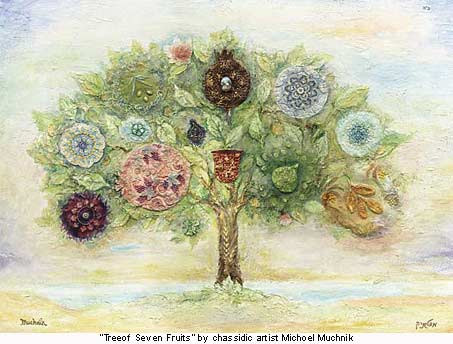
The seven fruits of the soul
My theological meanderings have brought me to Judaism. If I am to understand the foundation of my faith, I must understand where it came from. And Christianity is definitely born out of it's Jewish roots. The biblical condemnation of the Pharisees and centuries of anti-Semitism, I fear, have kept Christians from any deep look at our similarities.
That's where we get peace from, isn't it, not from highlighting our differences, but how we are fundamentally the same?
I've been transported by new ideas in the way that a Jewish scholar may approach the Bible. And don't think that all scholars approach the bible the same way. A treasure from the Jewish school, I think, is that reflection, questioning, and doubt are part of the curriculum.
So, anyways, I've been introduced to the concept of the seven fruits of the soul. In Chaddism, wheat, barley, grapes, figs, pomegranates, olives and dates have allegorical meanings beyond the plain reading of the text. Each represents a quality of man, specifically transcendence, vitality, joy, awareness, action, struggle and tranquility. The Jewish holiday of Yom Habikkurim celebrates rebirth in the spring and the first fruits of the harvest, including these seven traditional "fruits" of Isreal. For Christians, we would recognize this in the Old Testament as the feast of "first fruits".
What relevance does that have for us today? Well, in reflecting on our seven characteristics or needs, we might see where we are out of balance, or where one over-arching characteristic or need has overtaken our life. It might help, on self, reflection, to re-introduce balance in our lives.
Subscribe to:
Posts (Atom)