There's a peculiar type of destructive competition that happens in free market enterprises, when two fairly matched competitors mutually fail to dominate the market. We have Coke vs Pepsi, Ford vs GM. The differences between the products are minute, but human nature being what it is, fierce loyalties can be earned by either side.
I'm keen on merging and productivity. Our society is going to undertake a major shift in the next fifteen years. Economics will be turned on it's head. We will reach peak population growth. And climate change, an amorphous impersonal threat, will demand collaborative world-wide effort to stabilize. The old ways of competition won't stand up and all of us have to start thinking about getting along in new ways.
Here's one reason why I believe our society is heading for transformational change.
The destructive competition described above cannot survive this sort of transition. John Q. Consumer cannot expect a steady growth of his income, and so will instead be concerned about conservation of his assets. A free market economy must adapt, so the old consumer model will expire.
Consider the terrific opportunities and options that has come with world connectivity and personal electronics. We have some major players like Microsoft, Google, and Apple jockeying for dominance, and some critical bit players like the non-profit Wikipedia. Frankly, I cannot imagine returning to a life without my Wiki. But this multiplicity of options and fierce competition is handicapping the big players. I have a Microsoft computer who refuses to hold my Google search preference. I have Google docs who cheerfully allows one-way receipt of Microsoft documents, but won't translate back. Apple is unfriendly to both. And why not? They all grab a very profitable section of the market share, and the market continues to grow.
But this situation won't remain so, and the change will come quickly. My dream is that these titanic conflicts come to an agreeable end. So that my granddaughter can continue to enjoy the terrific opportunities of connectivity as our world turns on it's head.
Once upon a time there was a greek philosopher who, by persistently asking his leaders questions, was nicknamed the "Gnat of Athens". He did not consider it a perjorative. By his example, all of us should from time to time challenge our core beliefs - asking ourselves what moves us to do what we do. If our fundamental principles include "do no harm" and "protect the weak", are our institutions and our own behavior proof to what we believe?
Tuesday, September 1, 2015
Friday, July 10, 2015
Order
I'm following up on a question I got this week, asking "What is a taxonomy?" The google answer leads to the Tree of Life and the grand classification we've assigned to all living things on earth. That grand structure is getting an overhaul by the way, reclassifying creatures by parsing their DNA, rather than the traditional grouping by observable features.
But in the context of records management, "taxonomy" has been taken over to describe a particular discipline of classification of information. More on that later. I'm going to lead in to this by describing a few other concepts, from the most disordered to the most ordered. This is not the historical progression, by the way. We are now living in the "foksonomy" era, were order, apparently, has been taken over by the mob.
It is in our nature to classify and organize. It helps us leap past the irrelevant, whether literally or figuratively, and swiftly capture our prey. Does any classification schema work as well, or are there some underlying principles? By way of example, please spot the flaws in this hypothetical classification:
The Celestial Emporium of Benevolent Knowledge
a)
belonging to the Emperor
b) embalmed
c) tame
d) suckling pigs
e) sirens
f) fabulous
g) stray dogs
h) included in the present classification
i) frenzied
j) innumerable
k) drawn with a very fine camel-hair brush
l) et cetera
m) having just broken the water pitcher
n) that from a long way off look like flies
I suggest you take note of the flaws and take a moment to consider what makes them so wrong, because getting a sense of the possible flaws in a classification schema will save you worlds of hurt later.
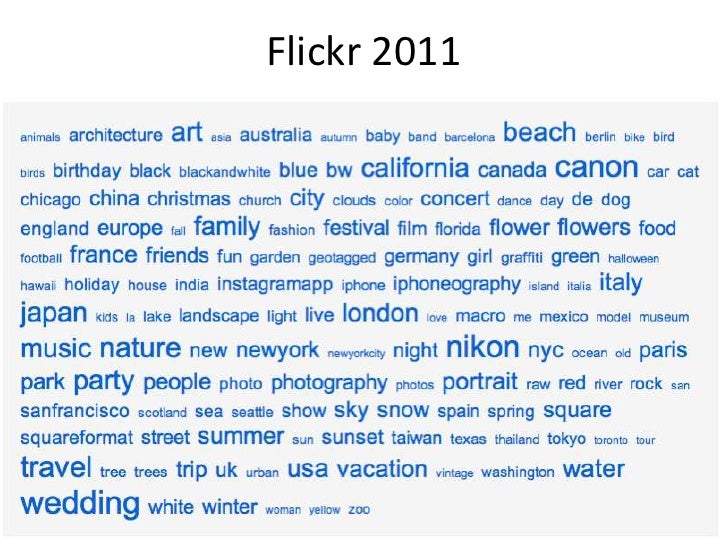
The second grade of order is the "folksonomy" where the masses decide how to title and index their entries, with no requirement to align with what has gone before. An example of folksonomy is the photo sharing site, Flickr, which invites users to tag their photos with whatever terms are meaningful to them. Folksonomies are best served by large user groups and sharing, to allow for common terms to dominate. Disorder gradually resolves to order. In this age of mass information sharing, folksonomies may be the only sensible way to establish any sort of order to the internet. There is no one group of dedicated professionals large enough to impose order to the sheer volume of information that is being generated.
Where folksonomies fail us is when a particular record needs to be found, consistently, permanently. We regularly come across these demands in business. For instance, it may not be critical to find the same information twice if we are planning a "california" "summer" "vacation" two years in a row. Google will be our friend and will happily give us the most popular result. There is no reassurance however, that we will get the same result two years' running. But if we need to find the "scope change" to "Project XYZ" that was asked for by our "Critical Customer" some time last fall, we better find that particular scope change. This level of order, where particular records must be found, demands a planned structure that is defined and managed.
The next level of order is covered by the general term "classification", and broadly describes our natural tendency to impose order. The slots or boxes that we use could be any useful structure; whether it be by location, features, or date.
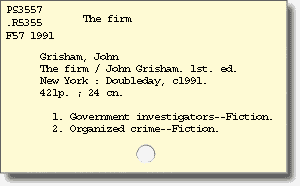
Before computer tagging, selecting the hierarchy of classification was critical, because the first order of organization would govern all that followed, the indexes that would be manually maintained, and so on. Take the classic library catalog card, for instance, and imagine the labor required to maintain the indexing.
This brief index includes the title, author, description, publisher, year published, cross index terms, and classification number (PS3557.R5355 F57 1991). From it's structure, I recognized this reference as the Library of Congress classification.
However, when I recall a book from the library these days, the default search screen is a single box. I put in a term that is significant to me, and the search engine cruises the entire index, all levels, all terms. Keep this in mind when setting up a hierarchical structure, that chances are users will bypass the structure altogether to find what they want, if the search tools are available.
Most common these days in business is to recommend a functional classification scheme. Where the hierarchical structure will reflect the functions of the business. This may be similar but not identical to the organizational structure. We don't want to re-order the records every time there is an organizational change. These schemes will be unique to the business, though there are some commonalities.
Here's one attempt to classify all business functions, developed by APQC:
Chances are you will recognize some of these titles as common to your business. In the APQC model, under each of these main categories, the functions are more fully described down to the activity level.
And, finally, we get to taxonomies. A taxonomy is a higher order classification that requires the rigor of organizing by function (what the organization does), in a hierarchical fashion from the most general to the most specific, while also defining synonyms, related terms, and cross references. A fully developed taxonomy will guide a user to the correct section of the index regardless of the term she uses. Development of such a taxonomy demands time with business users, to capture all of their business activities, say, in workflow diagrams, and to record their common terms.
Reference:
Folksonomies: A User-Driven Approach to Organizing Content by Joshua Porter, April 26, 2005
APQC.org
But in the context of records management, "taxonomy" has been taken over to describe a particular discipline of classification of information. More on that later. I'm going to lead in to this by describing a few other concepts, from the most disordered to the most ordered. This is not the historical progression, by the way. We are now living in the "foksonomy" era, were order, apparently, has been taken over by the mob.
It is in our nature to classify and organize. It helps us leap past the irrelevant, whether literally or figuratively, and swiftly capture our prey. Does any classification schema work as well, or are there some underlying principles? By way of example, please spot the flaws in this hypothetical classification:
The Celestial Emporium of Benevolent Knowledge
b) embalmed
c) tame
d) suckling pigs
e) sirens
f) fabulous
g) stray dogs
h) included in the present classification
i) frenzied
j) innumerable
k) drawn with a very fine camel-hair brush
l) et cetera
m) having just broken the water pitcher
n) that from a long way off look like flies
I suggest you take note of the flaws and take a moment to consider what makes them so wrong, because getting a sense of the possible flaws in a classification schema will save you worlds of hurt later.
The second grade of order is the "folksonomy" where the masses decide how to title and index their entries, with no requirement to align with what has gone before. An example of folksonomy is the photo sharing site, Flickr, which invites users to tag their photos with whatever terms are meaningful to them. Folksonomies are best served by large user groups and sharing, to allow for common terms to dominate. Disorder gradually resolves to order. In this age of mass information sharing, folksonomies may be the only sensible way to establish any sort of order to the internet. There is no one group of dedicated professionals large enough to impose order to the sheer volume of information that is being generated.
Where folksonomies fail us is when a particular record needs to be found, consistently, permanently. We regularly come across these demands in business. For instance, it may not be critical to find the same information twice if we are planning a "california" "summer" "vacation" two years in a row. Google will be our friend and will happily give us the most popular result. There is no reassurance however, that we will get the same result two years' running. But if we need to find the "scope change" to "Project XYZ" that was asked for by our "Critical Customer" some time last fall, we better find that particular scope change. This level of order, where particular records must be found, demands a planned structure that is defined and managed.
The next level of order is covered by the general term "classification", and broadly describes our natural tendency to impose order. The slots or boxes that we use could be any useful structure; whether it be by location, features, or date.
Before computer tagging, selecting the hierarchy of classification was critical, because the first order of organization would govern all that followed, the indexes that would be manually maintained, and so on. Take the classic library catalog card, for instance, and imagine the labor required to maintain the indexing.
This brief index includes the title, author, description, publisher, year published, cross index terms, and classification number (PS3557.R5355 F57 1991). From it's structure, I recognized this reference as the Library of Congress classification.
- P stands for Language and Literature.
- PS - American Literature
- 3557 covers the years 1961-2000 [I feel the whisper of the librarian's sigh. From PS1 to PS699, there is an attempt to sub-categorize American Literature by period, region, subject, poetry, prose..... No more it seems.]
This is an example of a hierarchical structure, that moves from the most general to the most detailed. A good design will guide a user to the most logical place for a record.
However, when I recall a book from the library these days, the default search screen is a single box. I put in a term that is significant to me, and the search engine cruises the entire index, all levels, all terms. Keep this in mind when setting up a hierarchical structure, that chances are users will bypass the structure altogether to find what they want, if the search tools are available.
Most common these days in business is to recommend a functional classification scheme. Where the hierarchical structure will reflect the functions of the business. This may be similar but not identical to the organizational structure. We don't want to re-order the records every time there is an organizational change. These schemes will be unique to the business, though there are some commonalities.
Here's one attempt to classify all business functions, developed by APQC:
Chances are you will recognize some of these titles as common to your business. In the APQC model, under each of these main categories, the functions are more fully described down to the activity level.
And, finally, we get to taxonomies. A taxonomy is a higher order classification that requires the rigor of organizing by function (what the organization does), in a hierarchical fashion from the most general to the most specific, while also defining synonyms, related terms, and cross references. A fully developed taxonomy will guide a user to the correct section of the index regardless of the term she uses. Development of such a taxonomy demands time with business users, to capture all of their business activities, say, in workflow diagrams, and to record their common terms.
Reference:
Folksonomies: A User-Driven Approach to Organizing Content by Joshua Porter, April 26, 2005
APQC.org
Friday, May 29, 2015
The dance of governments; a new cabinet
A habit hard to break is to analyse the latest cabinet shuffle. I caved to my craving this week and did a historical analysis of Alberta department creations, merges, and dissolutions. Editorials on cabinet shuffles tend to focus on partisan and regional agendas. Have the North and South been equally represented? How about regional/rural? Is everyone's pet agenda represented? How about gender and generational representation? But my concern is prosaic. How is this change affecting the departments themselves? From my many years working as a civil servant, I know the shuffle of a few
cabinet ministers results in a cascading effect resulting in the moving of 35,000
workers to new departments/ministries, new letterhead, different
offices. Sometimes it's a simple matter of contracting some sign painters and slapping on a fresh coat of paint. Other times department merges are more like "Clash of Cultures" Version 17.0.
Here's a Mind Map diagram representing all the department changes since the province's beginnings in 1905. In it you can read our government's and province's shifting priorities over time. I'm hoping you can zoom in to the detail.
Solid departments like Justice, Education, and Agriculture have always been with us, with minor adjustments to their portfolio. The minors like Culture and Parks are added, dissolved, re-established, merged, and tweaked to suit the day's fancy. Flash-in-the-pans were here and are pruned back to where they came from or off the agenda altogether, like Gaming and Consumer Affairs. Sometimes splits are reconsidered and two departments are absorbed back to their parent department.
When I finally added the latest cabinet portfolio to my diagram today, I noted some highlights.
An Administrative History of the Government of Alberta, The Provincial Archives of Alberta, 1905-2005
Here's a Mind Map diagram representing all the department changes since the province's beginnings in 1905. In it you can read our government's and province's shifting priorities over time. I'm hoping you can zoom in to the detail.
Solid departments like Justice, Education, and Agriculture have always been with us, with minor adjustments to their portfolio. The minors like Culture and Parks are added, dissolved, re-established, merged, and tweaked to suit the day's fancy. Flash-in-the-pans were here and are pruned back to where they came from or off the agenda altogether, like Gaming and Consumer Affairs. Sometimes splits are reconsidered and two departments are absorbed back to their parent department.
When I finally added the latest cabinet portfolio to my diagram today, I noted some highlights.
- The Status of Women get priority, not seen since 1938.
- Public Security/Safety is no longer it's own concern. This seemed to be a particular agenda of our last two governments.
- Children's Services similarly is absorbed in to it's parent department, though children do get a mention in the news release. And the Calgary Young Offender center is off the chopping block this week.
- Persons with Developmental Disabilities is also absorbed and gets no particular mention in cabinet. Likely a result of a smaller cabinet rather than a shift in priorities.
- Housing does not get it's own department either.
- And finally but not least of all, Sustainable Resource Development is all but gone. It's functions have been absorbed by Environment, Energy, and Agriculture.
Reference:
A new chapter in the story of Alberta, news release, Government of Alberta, May 24, 2015An Administrative History of the Government of Alberta, The Provincial Archives of Alberta, 1905-2005
Wednesday, May 6, 2015
The Enduring Bureaucrat, or, Everyone Needs Something to Do
Have you noted as I have how agencies, once established, endure well past their function? Consider the work of the foley artist.
This sound-effect job was birthed with radio, giving depth to radio drama, drawing the listener in to the action. With the advent of movies and television, though, the foley artist continued. Once a job is made, the enterprising continue to work hard to find their niche.
The same goes for the bureaucrat. Once graced with a budget, an enterprising bureaucrat will work hardest to justify his or her continued necessity, even perhaps at the cost of emerging needs. How does one go about disbanding an agency that has outlived it's usefulness? There will be protests and pain, for sure, as its supporters mourn it's loss.
An agency that may have outlived their origins for example, is the Victorian Order of Nurses (Florence Nightingale's practical nursing has proved itself more useful). In their history linked here, the VON use emotive language like "vital" and "treasure". Is there any service unique or valuable that the VON provide that could not be absorbed in to regular nursing? This is an example of an agency, budget, and bureaucracy that frankly, isn't needed.
Squirreling out obsoleted bureaucracies and agencies is one way to keep taxes low while improving service levels. This is not painless or simple though. There will be loud, emotive protests. This is the sort of activity that a new government may want to consider in the early days of their administration, before re-election looms.
Tuesday, April 14, 2015
Pleasurable Bagel
A bagel became the subject of a personal experiment this past weekend, where I used a mindfulness exercise over about twenty minutes, to eat several bites. I rate the experiment as a success, as the memory, texture, scent, alternate crispy and chewiness of the bagel and the warmth of the butter lingers on in my memory. Use of mindfulness is to extend the pleasure of a food by eating mindfully and in smaller quantities than I am used to. It's to prevent compulsive and mindless eating.
I might try and repeat a remembered pleasure by eating ever larger amounts of food. Pleasure eating releases ghrelin. Volume does not increase pleasure however. So even if food is not inherently addictive, it is tempting to follow the addict's course and try and coax the pleasure hormones forth in ever larger amounts. But if ghrelin is depleted, there will never be food enough to get back that remembered pleasure.
I've multiplied the pleasure while drastically reducing the quantity.
Planning started the night before, where I made some butter shells from unsalted butter. Room temperature for a lovely spread on the toast.
I timed and diarized the experience.
Buttered!
The bite used for the mindfulness exercise. There was a pleasing springiness. The crust, lovely to crunch down on. Because of the duration of the exercise, I became more aware of how the chewy center stuck to my teeth. Endured, really.
Here is the mindfulness clip I used. I realized in planning that with diarizing and capturing the experience, I could not afford to pause to read a script. So I used this YouTube.
Try this yourself and see if your pleasure is not multiplied many times over, with less food.
Thursday, April 2, 2015
Case study of a Management and Recordkeeping Failure
Back in the fall of 2012 I watched a meat recall with interest. You might remember this one; it involved a large meat packing plant called XL foods located in southern Alberta. I was alerted when the company failed to respond promptly for a request for records. My "records radar" was activated, and I just knew that part of the issue had to be poor record-keeping and perhaps a failure of management as well.
The affected meat was identified and recalled within days, and the incident quickly faded from public interest. An independent review of the incident was quietly published many months later.
I finally got around this week to confirming if my instincts were right, and the review indeed validates my first instinct. It turns out this failure is a good lesson on the importance of not only following the letter of the law but the spirit as well. Good record-keeping and alert quality practices are evidence of a quality culture that can't be faked. Management and personnel throughout the organization must be committed to the principles behind our regulations, to prevent these sorts of incidents from re-occurring.
Conclusion
Management that values their reputation for quality will demonstrate their values by not only making sure that all those activities and reporting required by regulation are done, but by following up on any irregularities. If there is a testing and reporting protocol, analyse those results and follow up on any defects. Conduct root cause analysis on re-occurring problems. Keep current and careful records, and make sure plant staff have the information required to quickly locate batches in process.
Support teams do not operate in isolation. When an emergent issue arises, include key personnel throughout the company to build a team to help the Quality Manager to respond.
Once an emergency protocol is developed, have regular and effective drills to test that protocol and train staff in how to implement it. This could have prevented the chaos that followed and perhaps allowed the company to recover more quickly.
W. Ronald Usborne, PhD
May 2013
We found a relaxed attitude towards applying mandatory procedures – clearly outlined in some documents, less so in others. Again, a shortcoming shared by both plant and [Canadian Food Inspection Agency] CFIA staff....In short, we found a weak food safety culture at the Brooks plant, shared by both plant management and CFIA staff.
The company's Quality Assurance Manager confirmed that turnover was some 30% each year at the Brooks plant.
Sampling spreadsheets studied by the Panel show high event periods (HEPs) very clearly. We found no indication that the company was identifying and analyzing those results for trends during the time leading up to the identification of the E. coli O157:H7 contamination; consequently, it was unable to make any efforts to establish and correct the root cause of the problem.
...the Panel reviewed sampling data as far back as January 2012, and noted a number of HEPs that should have resulted in root cause analyses by XL Foods Inc., but we have no evidence to suggest any analysis actually occurred. The company had established action limits at 10%, 20%, but there was no indication of how the action limits were linked to the sampling program.
XL Foods Inc.'s recordkeeping of monitoring activities and its validation of procedures and equipment maintenance were found to be deficient. In addition, sampling techniques were inconsistent. These shortcomings should have been identified by CFIA inspectors before the contamination event occurred.
The information first handed to CFIA was coded and could therefore not be acted upon by the regulator; product distribution information was kept at the company's corporate offices off site, which was slow to arrive at the plant. The company did not follow the recall section of the [Food Safety Emergency Protocol] FSEP Manual, which would have made the retrieval of records timely. During this lost time, contaminated product continued to be sold and eaten, unnecessarily exposing additional consumers to a potentially serious health risk.
Even after the regulator formalized its request in writing the following day, CFIA staff repeatedly extended deadlines for receiving the required data. Each day that passed before contaminated products were recalled allowed them to make their way further along the supply chain and into consumers' food baskets.
The XL Foods Inc.'s Quality Assurance Manager may have been unsure about which request was the most pressing, or was overwhelmed with the volume of information requested. It appears that he did not establish a team to assist with the work, and was determined to address these requests singlehandedly while continuing to perform his regular duties.
It is the Panel's view that equipment maintenance and sanitation were significant problems at the plant.
The fact that the company did not pay attention to increasing E. coli O157:H7 positive tests of beef trim had several consequences: it did not identify a high event period (HEP), it did not bracket product adequately, it missed contaminated products, and these then left the establishment. In addition, because plant staff was not reviewing sampling data, the HEP was not identified. Consequently, there was no attempt to determine a root cause, and the contamination continued unchecked until it was picked up outside the plant at Ginger Beef Choice Ltd. and the US border.
XL Foods Inc.'s Hazard Analysis and Critical Control Point system was neither applied nor managed properly. This is evidenced by the absence of detailed documentation, inconsistent trend analysis, insufficient record keeping on monitoring and validating processes and equipment maintenance, inconsistent sampling, etc. Annual quality verifications of inspection activities (a component of CFIA's Quality Management System) indicated that these were not delivered with scheduled regularity.
The six-day delay in providing this information – while the plant remained in operation and no root cause had been identified – meant that contaminated product continued to be produced and shipped from the plant.
3. Inspectors should devote proportionately less time to evaluating specimens for pathology and more time training on protocols that have maximum impact on food safety.
To improve the effectiveness of inspectors, CFIA should assess the specific duties their inspectors perform, with a view to evaluating the direct impact of these duties on food safety. More effort should be committed to evaluating trends, and assisting plant staff with root cause analysis when contamination is detected. They should also spend more time evaluating the thoroughness of cleaning and sanitation before shift start-ups.
5. The CFIA must enforce its oversight responsibilities at the plant.
Examples of these responsibilities include, among several others:
2012, August 24, 27, 28, 29 and September 5 - the five dates where E Coli outbreak occurred.
2012, September 3 - E Coli found in a shipment of beef to the US.
2012, September 4 - Canadian inspectors found E Coli during routine testing.
2012, September 7, XL Foods Inc. was formally requested in writing to produce detailed information related to product details, distribution, sampling results, and information on the effectiveness of the plant's preventative controls as soon as possible but no later than September 8.
2012, September 10, 1 - Pursuant to CFIA requests to XL Foods Inc. on September 6 and 7, information from XL Foods Inc. was provided to the CFIA in a series of submissions over two days.
2012, September 12 - more E Coli is found.
2012, September 14 -The CFIA team completes review and reports that XL Foods Inc. must improve its trend analysis on high event days (periods when positive sampling tests are higher than normal) and follow documented procedures.
2012 September 16 - recall of tainted meat and public announcement.
2012, September 27 - the plant is shut down because of the outbreak, until company officials “..have demonstrated that they have fully implemented CFIA’s required corrective action,” Problems identified in a “corrective action” notice include employees touching contaminated meat without cleaning their hands properly and “water nozzles clogged in the primary carcass wash area.”
2012, October 18 - it was announced that the XL Lakeside plant was to be taken over by JBS USA for 60 days with "an exclusive option to buy the Canadian and U.S. operations of XL Foods".
2012, October 19 - The CFIA receives test results for the carcasses that the company processed between October 12 and October 17. Both CFIA and XL Foods Inc. test results for these carcasses are negative for E. coli.
2013, January 14 JBS Foods, Brazil, buys XL foods
2013, May - the Canadian Food Agency publishes an independent review of the XL Foods incident
Related Articles:
http://www.inspection.gc.ca/food/information-for-consumers/food-safety-investigations/xl-foods-inc-independent-review-/eng/1370367689068/1370367776627
http://www.inspection.gc.ca/food/information-for-consumers/food-safety-investigations/xl-foods/timeline/eng/1349149063487/1349149874246
http://www.cbc.ca/news/canada/ottawa-launches-review-into-xl-foods-e-coli-outbreak-1.1358402
http://www.theglobeandmail.com/news/national/xl-foods-asks-to-resume-operations-after-e-coli-outbreak/article4596586/
http://www.theglobeandmail.com/news/national/e-coli-outbreak-at-alberta-beef-plant-sign-of-a-system-in-overhaul/article4576587/
http://en.wikipedia.org/wiki/XL_Foods
http://www.huffingtonpost.ca/2013/01/09/jbs-buys-xl-foods-brazilian-company-alberta-beef-recall-ecoli_n_2443042.html
http://www.thestar.com/opinion/editorialopinion/2012/10/08/alberta_meat_packing_plant_has_troubled_history.html
The affected meat was identified and recalled within days, and the incident quickly faded from public interest. An independent review of the incident was quietly published many months later.
I finally got around this week to confirming if my instincts were right, and the review indeed validates my first instinct. It turns out this failure is a good lesson on the importance of not only following the letter of the law but the spirit as well. Good record-keeping and alert quality practices are evidence of a quality culture that can't be faked. Management and personnel throughout the organization must be committed to the principles behind our regulations, to prevent these sorts of incidents from re-occurring.
Internal Defect Phase
For two weeks leading up to the first failed test at the US border, internal tests at XL foods found four positive tests for e-coli. Quality Assurance protocols were followed, and the batches of tainted meat were removed. However, these tests (High Event Periods or HEP) should also have alerted the company that there was a systemic issue, requiring resolution. This would have been evidence of Quality Management at work. Testing and reporting are not only for compliance but for analysis and action. Perhaps there was action taken, but there are no records to indicate that there were. An alert company intent on excellence would have acted on these results internally and would have protected the company from the public embarrassment and losses that followed. They would have also documented their actions as evidence of their accountability.External Incident
The next few weeks are marked by increasing external evidence of the failure, caught by watchdogs both at the US border and by the Canadian inspection agency. This led to increasing demands for action and information from XL foods. The XL Foods Quality Manager was ill-prepared to meet the increasing demands and was not able to produce information in a timely manner to the Canadian Food Inspection Agency (CFIA).Public Shame
Finally on September 16, thirteen days after the first tainted meat result caught by the US customs officials, the CFIA made public the failure and ordered a recall.Failed Recovery
Over the weeks that followed, XL foods struggled to implement all the demands of the CFIA. In the meantime, production is slowed then shut down, employees are laid off, and any meat left in production is rendered safe (cooked) and disposed of. Finally on October 18, management of the plant is turned over to IBS foods which eventually takes ownership.Conclusion
Management that values their reputation for quality will demonstrate their values by not only making sure that all those activities and reporting required by regulation are done, but by following up on any irregularities. If there is a testing and reporting protocol, analyse those results and follow up on any defects. Conduct root cause analysis on re-occurring problems. Keep current and careful records, and make sure plant staff have the information required to quickly locate batches in process.
Support teams do not operate in isolation. When an emergent issue arises, include key personnel throughout the company to build a team to help the Quality Manager to respond.
Once an emergency protocol is developed, have regular and effective drills to test that protocol and train staff in how to implement it. This could have prevented the chaos that followed and perhaps allowed the company to recover more quickly.
Independent Review of XL Foods Inc. Beef Recall 2012 Ronald John Lewis, DVM - Excerpts
(Chair) André Corriveau MDW. Ronald Usborne, PhD
May 2013
We found a relaxed attitude towards applying mandatory procedures – clearly outlined in some documents, less so in others. Again, a shortcoming shared by both plant and [Canadian Food Inspection Agency] CFIA staff....In short, we found a weak food safety culture at the Brooks plant, shared by both plant management and CFIA staff.
The company's Quality Assurance Manager confirmed that turnover was some 30% each year at the Brooks plant.
Sampling spreadsheets studied by the Panel show high event periods (HEPs) very clearly. We found no indication that the company was identifying and analyzing those results for trends during the time leading up to the identification of the E. coli O157:H7 contamination; consequently, it was unable to make any efforts to establish and correct the root cause of the problem.
...the Panel reviewed sampling data as far back as January 2012, and noted a number of HEPs that should have resulted in root cause analyses by XL Foods Inc., but we have no evidence to suggest any analysis actually occurred. The company had established action limits at 10%, 20%, but there was no indication of how the action limits were linked to the sampling program.
XL Foods Inc.'s recordkeeping of monitoring activities and its validation of procedures and equipment maintenance were found to be deficient. In addition, sampling techniques were inconsistent. These shortcomings should have been identified by CFIA inspectors before the contamination event occurred.
The information first handed to CFIA was coded and could therefore not be acted upon by the regulator; product distribution information was kept at the company's corporate offices off site, which was slow to arrive at the plant. The company did not follow the recall section of the [Food Safety Emergency Protocol] FSEP Manual, which would have made the retrieval of records timely. During this lost time, contaminated product continued to be sold and eaten, unnecessarily exposing additional consumers to a potentially serious health risk.
Even after the regulator formalized its request in writing the following day, CFIA staff repeatedly extended deadlines for receiving the required data. Each day that passed before contaminated products were recalled allowed them to make their way further along the supply chain and into consumers' food baskets.
The XL Foods Inc.'s Quality Assurance Manager may have been unsure about which request was the most pressing, or was overwhelmed with the volume of information requested. It appears that he did not establish a team to assist with the work, and was determined to address these requests singlehandedly while continuing to perform his regular duties.
It is the Panel's view that equipment maintenance and sanitation were significant problems at the plant.
The fact that the company did not pay attention to increasing E. coli O157:H7 positive tests of beef trim had several consequences: it did not identify a high event period (HEP), it did not bracket product adequately, it missed contaminated products, and these then left the establishment. In addition, because plant staff was not reviewing sampling data, the HEP was not identified. Consequently, there was no attempt to determine a root cause, and the contamination continued unchecked until it was picked up outside the plant at Ginger Beef Choice Ltd. and the US border.
XL Foods Inc.'s Hazard Analysis and Critical Control Point system was neither applied nor managed properly. This is evidenced by the absence of detailed documentation, inconsistent trend analysis, insufficient record keeping on monitoring and validating processes and equipment maintenance, inconsistent sampling, etc. Annual quality verifications of inspection activities (a component of CFIA's Quality Management System) indicated that these were not delivered with scheduled regularity.
The six-day delay in providing this information – while the plant remained in operation and no root cause had been identified – meant that contaminated product continued to be produced and shipped from the plant.
3. Inspectors should devote proportionately less time to evaluating specimens for pathology and more time training on protocols that have maximum impact on food safety.
To improve the effectiveness of inspectors, CFIA should assess the specific duties their inspectors perform, with a view to evaluating the direct impact of these duties on food safety. More effort should be committed to evaluating trends, and assisting plant staff with root cause analysis when contamination is detected. They should also spend more time evaluating the thoroughness of cleaning and sanitation before shift start-ups.
5. The CFIA must enforce its oversight responsibilities at the plant.
Examples of these responsibilities include, among several others:
- ...
- As also required under FSEP, in the event of a recall, the plant must provide the Agency with distribution records for the recalled products that are complete and in a format that is accessible.
- Also in accordance with FSEP, the plant must include all of its standard operating procedures and good manufacturing practices in its own food safety plan.
Timeline:
2009 - XL Foods bought Lakeside Packers from its U.S. parent company Tyson Foods[3]2012, August 24, 27, 28, 29 and September 5 - the five dates where E Coli outbreak occurred.
2012, September 3 - E Coli found in a shipment of beef to the US.
2012, September 4 - Canadian inspectors found E Coli during routine testing.
2012, September 7, XL Foods Inc. was formally requested in writing to produce detailed information related to product details, distribution, sampling results, and information on the effectiveness of the plant's preventative controls as soon as possible but no later than September 8.
2012, September 10, 1 - Pursuant to CFIA requests to XL Foods Inc. on September 6 and 7, information from XL Foods Inc. was provided to the CFIA in a series of submissions over two days.
2012, September 12 - more E Coli is found.
2012, September 14 -The CFIA team completes review and reports that XL Foods Inc. must improve its trend analysis on high event days (periods when positive sampling tests are higher than normal) and follow documented procedures.
2012 September 16 - recall of tainted meat and public announcement.
2012, September 27 - the plant is shut down because of the outbreak, until company officials “..have demonstrated that they have fully implemented CFIA’s required corrective action,” Problems identified in a “corrective action” notice include employees touching contaminated meat without cleaning their hands properly and “water nozzles clogged in the primary carcass wash area.”
2012, October 18 - it was announced that the XL Lakeside plant was to be taken over by JBS USA for 60 days with "an exclusive option to buy the Canadian and U.S. operations of XL Foods".
2012, October 19 - The CFIA receives test results for the carcasses that the company processed between October 12 and October 17. Both CFIA and XL Foods Inc. test results for these carcasses are negative for E. coli.
2013, January 14 JBS Foods, Brazil, buys XL foods
2013, May - the Canadian Food Agency publishes an independent review of the XL Foods incident
CFIA Review panel:
They include Ronald Lewis, former chief veterinary officer for British Columbia; Dr. Andre Corriveau, chief public health officer for the Northwest Territories; and Ronald Usborne, a former executive with Caravelle Foods.Related Articles:
http://www.inspection.gc.ca/food/information-for-consumers/food-safety-investigations/xl-foods-inc-independent-review-/eng/1370367689068/1370367776627
http://www.inspection.gc.ca/food/information-for-consumers/food-safety-investigations/xl-foods/timeline/eng/1349149063487/1349149874246
http://www.cbc.ca/news/canada/ottawa-launches-review-into-xl-foods-e-coli-outbreak-1.1358402
http://www.theglobeandmail.com/news/national/xl-foods-asks-to-resume-operations-after-e-coli-outbreak/article4596586/
http://www.theglobeandmail.com/news/national/e-coli-outbreak-at-alberta-beef-plant-sign-of-a-system-in-overhaul/article4576587/
http://en.wikipedia.org/wiki/XL_Foods
http://www.huffingtonpost.ca/2013/01/09/jbs-buys-xl-foods-brazilian-company-alberta-beef-recall-ecoli_n_2443042.html
http://www.thestar.com/opinion/editorialopinion/2012/10/08/alberta_meat_packing_plant_has_troubled_history.html
Talismans of Rememberance
Today's writing prompt asks if I carry any good luck charms?
There are cultures where the contents of the medicine bag are kept private, as that information can be used against the wearer. Who is my spirit guide? I'm not telling! But my personal traditions are different and I have no fear of these being stolen from me.
There are two items I wear nearly every day that have special meaning. The first is a topaz necklace, the inheritance from my mother last year. As grim as it can be tucking away a loved-one for the last time, this small gift has turned out to mean more than I could have imagined. Mom used to take it out at our visits, reminding me where she kept it and explaining that I was to make sure this keepsake and my sibling's were to be delivered where she intended. I hated those reminders when I visited, because I was far less interested in her death and her gifts, than spending time with her living self. But it sure was helpful when the time came to know of that envelope, where it was, and what mom intended.
I wear that necklace often, and it turns out to remind me more of all the good things that mom added to my life. This little necklace covers over bitter memories, leaving me comforted and at peace. A good and appropriate inheritance.
The other talisman is a Run Happy band from Brooks.
Kind of for obvious reasons. Running is part of my new life, and this silly band reminds me.
Subscribe to:
Posts (Atom)