Having run out of pulp fiction this weekend, I dived in to my collection of classics I had picked up the last time I visited Never Without a Book. (This little second-hand bookstore in Northeast Edmonton is a treasure all in itself. Local bibliophiles owe it to themselves a visit.) The Stone Diaries by Carol Shields, weaves tale of woman in a most fantastical interior shape, a carrot grown in a rocky bed. The story also carries me through the modern history of a corner of Canada; also real in it's taste and sounds.
Very much like my family this one, volumes told by all that is left unsaid.
This worthy book has a few quotes I must keep. Here they are:
Of siblings reminiscing, "They shudder with the heat of their own dramas, awestruck by the doubleness of memory, the hold it has on them, as mysterious as telephone wires or the halo around the head of the baby Jesus. Memory could be poked with a stick, savoured in the mouth like a popsicle, you could never get enough of it." (Motherhood, page 175)
Of a father in the twilight of his life, choosing a new path, "...jubilant, anethetized against tomorrow's faint heart and second thoughts, uncertain whether he was moving close to the center of his life or selling off some valuable part of himself. But immediately, with a shudder of joy, he knew what might be done, could be done. Happiness coursed through him in that instant, decision's homely music." (Ease, page 277)
The same father's regret, "...there are chambers, he knows, in the most ordinary lives that are never entered; let alone advertised, and yet they lie pressed againsts the consciousness like leave specimens in an old book." (Ease, page 279)
Monday, May 7, 2012
Sunday, November 13, 2011
Martin Luther King and Occupy
It's been a while since I blogged. Sorry about that. I've been busy relocating to Grande Cache, acquainting myself with the town and the new job, and getting used to the elevation. The view out my window is a bit of rugged bush, pretty average for this part of the country. The weather is unusual today; half the sky is blue and the other half is grim. We are on the grim half of town. A dusting of snow whips by.

Anyways, I am taking a moment to capture the big thoughts I had while finishing "Martin Luther King Jr., His life, martyrdom and meaning for the world" by Willaim Robert Miller. Written by a pacifist, this biography offers a balanced picture of Dr. Martin King. His stellar achievements and crushing doubts are described equally faithfully. Offered most sympathetically are Dr. King's views on pacifism. In short, push leaders to change - and change now - before the pressure cooker explodes. To the demonstrators, be generous in victory; suppress the urge for revenge. Only this way can positive change result. Here are a few quotes I am preserving,
"[On Mordecai Johnson] ...he had shown ho to harness the redemptive power of love to social issues, and through it, change had come." (p. 30)
"...but both Brightman and his associate, L. Harold DeWolf, had a permanent effect in shaping Martin's lifelong belief in a personal God and in the dignity and worth of every human person." (p. 34)
"King told the crowd that the was often advised to slow down the pace of the freedom revolution, that time would tke care of things. But time is neutral.'It can be used constructively and it can be used destructively. Unfortunately, the extremist, right-wing elements use their time more effectively."...Racism, he said, was a way of life for the vast majority of white Americans. The Poor People's Campaign had to control this ... The campaign would 'call attention to the gap between promises and fulfillment - to make the invisible visible.'" (p. 285)
"The death of Martin Luther King was not the cause of rioting but its occasion...King knew the reasons it was there, and he had pointed them out again and again. If this represented 'criminality', it was not something inborn but the direct result of continuous oppression, the denial of hope, the rejection of repeated appeals." (p. 293)
The big lessons in Dr. King's life are echoed today with the occupy demonstrations sweeping North America. The lessons learned when an oppressed people raise themselves up must not be ignored. Let's also not forget the danger to the unaware oppressors, of deliberate blindness, a dulling of the conscience, where stories of cruelty are suppressed or plainly disbelieved. It is too easy to polarize, demonize, belittle, and ignore change agents. If these people are our brothers, what does it say when we refuse to listen, to respond?
The same dynamics were repeated in the tumultuous modern history of Africa, that I read this past year. Ignorant oppressors are justifiably afraid of public demonstrations pointing out the less pretty side of society. Because the oppressed, once expressed, are on just this shade of violence. If they continue to be ignored.
I believe Dr. King's Poor People's Campaign was visionary. A nation that ignores it's weakest remains vulnerable. I believe these vulnerabilities have never been fullly addressed.
Just last week I posted my mixed feelings about the occupy demonstrators on a discussion board,
"There are shades of history that caution me from judgement. I'm wavering between admiration and annoyance.
•First of all, these kids are not the "other 99". They are a particular subset of society that for whatever reason, has time to check out from routine. I resent that they claim to represent me.
•I resent the 99 as much as I have come to resent the so-called "Moral Majority". As soon as the Religious Right DID gain power, they bankrupted the country. They also make poor losers.
•So I see a correlation between the "other 99" and the "Moral Majority". Both claim to represent an invisible and silent minority; both are more dogmatic than sensible. They should own up that they represent their own sectarian interests.
•To the protester's defence, I think the widening gap between rich and poor is a dreadful testament for a wealthy country. I studied the Human Development index published by the United Nations a few years ago. That widening gap is a pretty good darn indicator that at some point something was going to snap. It is not the richest who earn a nation's pride, it's the country's poorest. What are we doing for those most disadvantaged? There must be a rebalancing of wealth. If the wealthiest won't do it voluntarily, the government (vocal, voted majority) should intervene.
•Be cautious in accepting wild stories happening at these sit-ins. Remember that the boomers of today were hippie protesters of yesteryear. The establishement reacted badly back than. I would like my generation to show greater tolerance. We don't have to set out the dogs or tear gas, do we?"
In conclusion, even though I am doubtful that the demonstrators represent the "other 99", and skeptical of their choice of demons (Corporate America, Big Business), they do express a raging unmet need.
Leaders listen.
As a postscript, I found the story of Dr. King's emerging faith during college to be personally inspiring. It is encouraging to read how a man with highly individual and tested beliefs could find his way in his church of choice. I'm not so sure the denominations of today have fully taken up his challenge of social responsibility. I note that even the liberal churches today are content to passively petition their governments to do more. There must be personal involvement, I would think, for active change to come about.
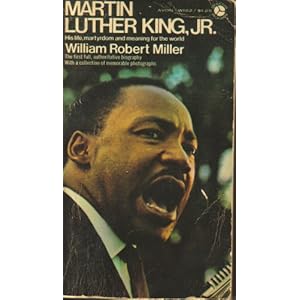
Anyways, I am taking a moment to capture the big thoughts I had while finishing "Martin Luther King Jr., His life, martyrdom and meaning for the world" by Willaim Robert Miller. Written by a pacifist, this biography offers a balanced picture of Dr. Martin King. His stellar achievements and crushing doubts are described equally faithfully. Offered most sympathetically are Dr. King's views on pacifism. In short, push leaders to change - and change now - before the pressure cooker explodes. To the demonstrators, be generous in victory; suppress the urge for revenge. Only this way can positive change result. Here are a few quotes I am preserving,
"[On Mordecai Johnson] ...he had shown ho to harness the redemptive power of love to social issues, and through it, change had come." (p. 30)
"...but both Brightman and his associate, L. Harold DeWolf, had a permanent effect in shaping Martin's lifelong belief in a personal God and in the dignity and worth of every human person." (p. 34)
"King told the crowd that the was often advised to slow down the pace of the freedom revolution, that time would tke care of things. But time is neutral.'It can be used constructively and it can be used destructively. Unfortunately, the extremist, right-wing elements use their time more effectively."...Racism, he said, was a way of life for the vast majority of white Americans. The Poor People's Campaign had to control this ... The campaign would 'call attention to the gap between promises and fulfillment - to make the invisible visible.'" (p. 285)
"The death of Martin Luther King was not the cause of rioting but its occasion...King knew the reasons it was there, and he had pointed them out again and again. If this represented 'criminality', it was not something inborn but the direct result of continuous oppression, the denial of hope, the rejection of repeated appeals." (p. 293)
The big lessons in Dr. King's life are echoed today with the occupy demonstrations sweeping North America. The lessons learned when an oppressed people raise themselves up must not be ignored. Let's also not forget the danger to the unaware oppressors, of deliberate blindness, a dulling of the conscience, where stories of cruelty are suppressed or plainly disbelieved. It is too easy to polarize, demonize, belittle, and ignore change agents. If these people are our brothers, what does it say when we refuse to listen, to respond?
The same dynamics were repeated in the tumultuous modern history of Africa, that I read this past year. Ignorant oppressors are justifiably afraid of public demonstrations pointing out the less pretty side of society. Because the oppressed, once expressed, are on just this shade of violence. If they continue to be ignored.
I believe Dr. King's Poor People's Campaign was visionary. A nation that ignores it's weakest remains vulnerable. I believe these vulnerabilities have never been fullly addressed.
Just last week I posted my mixed feelings about the occupy demonstrators on a discussion board,
"There are shades of history that caution me from judgement. I'm wavering between admiration and annoyance.
•First of all, these kids are not the "other 99". They are a particular subset of society that for whatever reason, has time to check out from routine. I resent that they claim to represent me.
•I resent the 99 as much as I have come to resent the so-called "Moral Majority". As soon as the Religious Right DID gain power, they bankrupted the country. They also make poor losers.
•So I see a correlation between the "other 99" and the "Moral Majority". Both claim to represent an invisible and silent minority; both are more dogmatic than sensible. They should own up that they represent their own sectarian interests.
•To the protester's defence, I think the widening gap between rich and poor is a dreadful testament for a wealthy country. I studied the Human Development index published by the United Nations a few years ago. That widening gap is a pretty good darn indicator that at some point something was going to snap. It is not the richest who earn a nation's pride, it's the country's poorest. What are we doing for those most disadvantaged? There must be a rebalancing of wealth. If the wealthiest won't do it voluntarily, the government (vocal, voted majority) should intervene.
•Be cautious in accepting wild stories happening at these sit-ins. Remember that the boomers of today were hippie protesters of yesteryear. The establishement reacted badly back than. I would like my generation to show greater tolerance. We don't have to set out the dogs or tear gas, do we?"
In conclusion, even though I am doubtful that the demonstrators represent the "other 99", and skeptical of their choice of demons (Corporate America, Big Business), they do express a raging unmet need.
Leaders listen.
As a postscript, I found the story of Dr. King's emerging faith during college to be personally inspiring. It is encouraging to read how a man with highly individual and tested beliefs could find his way in his church of choice. I'm not so sure the denominations of today have fully taken up his challenge of social responsibility. I note that even the liberal churches today are content to passively petition their governments to do more. There must be personal involvement, I would think, for active change to come about.


Tuesday, June 21, 2011
The Glory of the Hunt
People care about their files. They are attached to the personal systems they put in place to find what they need, and become anxious if they are taken away. The file system is guarded territory, as fiercly protected as a parking stall.
It became clear years ago that it is not enough, as a records professional to build a pure filing system - elegant in design and intuitive to use. If I have not engaged the very human customers where they work and live, the system will fail.
Quoting google advanced help, "Search engines use a variety of techniques to imitate how people think and to approximate their behavior. As a result, most rules have exceptions. For example, the query[ for better or for worse ] will not be interpreted by Google as an OR query, but as a phrase that matches a (very popular) comic strip. Google will show calculator results for the query [ 34 * 87 ] rather than use the 'Fill in the blanks' operator. Both cases follow the obvious intent of the query." This means rather than being straightforward, search support services spend a lot of time getting inside the heads of searchers, to help them get the results they want (not what they say they want).
So how do we stow away and find things? It could be that our personal classification systems and style of hunting (foraging) are as established as our hunter-gatherer brains. Web and corporate Enterprise Content Management (ECM) systems have vastly extended our reach, but our searching instincts have not changed.
I will suggest that classifying and searching, tagging and recalling successful hunts, are part of our instinctive heritage. Steven Pinker in his book the Language Instinct, proposes fifteen instincts that are hard-wired in to all of us. Two of these instincts relate to searching and classifying:
4. Mental maps for large territories.
11. A mental Rolodex; a database of individuals, with blanks for kinship, status or rank, history of exchange of favors, and inherent skills and strengths, plus criteria that valuate each trait.
Imagining our forbear's steps, I imagined my ancestor following a familiar trail, noting edible plants along the way. She would retrace her steps later, when she knew the harvest would be ready; wild carrots in the summer, cattail tubers in the fall, and rose hips through the winter. She would have identified and classifed the edible plants, and remembered the trail to get there.
![]() I couldn't find a comparable image on my google search, so I scanned my own, I did learn a little about the foraging habits of water pipits, larval green lacewings, and modern human urban foragers.
I couldn't find a comparable image on my google search, so I scanned my own, I did learn a little about the foraging habits of water pipits, larval green lacewings, and modern human urban foragers.
So in many ways, classifying and searching is instinctive. We care about the results of the hunt, and not just for the practical purpose of getting the job done. This is personal.
You know what I am talking about. Anyone in our business will have hit a tough search that evades early detection. We dig in ever harder, searching out the obscure places where it might have been put. To place that record in our bosses hands, sweet.
The hunt is valued. A swift and successful hunt gives value to the organization. A hunter who provides consistent results is an asset; not just from an empirical, practical point of view, but at an instinctive, visceral level. I suggest again that if the GARP(C) principles were to be ranked, Availability is at the top. Not so say that the rest may be discarded. Together, they complete the framework for a robust records system.
When converting to a new file structure, be respectful of people's need to find their stuff. Anticipate the anxiety that accompanies change, and prepare for it. Make sure they have time to orient themselves to the new system, and reassure them that the materials they need daily will be at hand.
It became clear years ago that it is not enough, as a records professional to build a pure filing system - elegant in design and intuitive to use. If I have not engaged the very human customers where they work and live, the system will fail.
Quoting google advanced help, "Search engines use a variety of techniques to imitate how people think and to approximate their behavior. As a result, most rules have exceptions. For example, the query
So how do we stow away and find things? It could be that our personal classification systems and style of hunting (foraging) are as established as our hunter-gatherer brains. Web and corporate Enterprise Content Management (ECM) systems have vastly extended our reach, but our searching instincts have not changed.
I will suggest that classifying and searching, tagging and recalling successful hunts, are part of our instinctive heritage. Steven Pinker in his book the Language Instinct, proposes fifteen instincts that are hard-wired in to all of us. Two of these instincts relate to searching and classifying:
4. Mental maps for large territories.
11. A mental Rolodex; a database of individuals, with blanks for kinship, status or rank, history of exchange of favors, and inherent skills and strengths, plus criteria that valuate each trait.
Imagining our forbear's steps, I imagined my ancestor following a familiar trail, noting edible plants along the way. She would retrace her steps later, when she knew the harvest would be ready; wild carrots in the summer, cattail tubers in the fall, and rose hips through the winter. She would have identified and classifed the edible plants, and remembered the trail to get there.

So in many ways, classifying and searching is instinctive. We care about the results of the hunt, and not just for the practical purpose of getting the job done. This is personal.
You know what I am talking about. Anyone in our business will have hit a tough search that evades early detection. We dig in ever harder, searching out the obscure places where it might have been put. To place that record in our bosses hands, sweet.
The hunt is valued. A swift and successful hunt gives value to the organization. A hunter who provides consistent results is an asset; not just from an empirical, practical point of view, but at an instinctive, visceral level. I suggest again that if the GARP(C) principles were to be ranked, Availability is at the top. Not so say that the rest may be discarded. Together, they complete the framework for a robust records system.
When converting to a new file structure, be respectful of people's need to find their stuff. Anticipate the anxiety that accompanies change, and prepare for it. Make sure they have time to orient themselves to the new system, and reassure them that the materials they need daily will be at hand.
Monday, June 20, 2011
Advanced Search in the New Age
I've struggled with this subject all day. It's hard to pin down why. I enjoy running a great search, and I'm good at it. I think it must be because many of the tips and tools I'm highlighting, are as natural to use as breathing. It's tough not to step over my own feet when laboriously laying out all the steps. The problem these days - on google at least - is not the absence of results. The problem is too many results from a simple search.
When the internet was new, my girlfriend showed off her google search for "superman". Her son was a comic book buff, and she and her son marvelled at the speed of the return; four hits. When she demonstrated for me a couple months later, we found twenty sites. And goggled. My, how the internet was growing in leaps and bounds. Today, a google search on the same term gave me 168 million hits. My mind boggles at that number. In truth, I won't look past a couple pages. The likelihood that I would find a significant result any deeper is just too small.
To make sense of this mass of information at our fingertips has made search an art. Find a term significant and unique enough to bring back the result I need, but not so narrow that it filters out the gold. A way to develop this fine touch is to start with the narrowest search you can think of. Try enclosing your google phrase in quotation marks. If you get no results, broaden your search ever more slightly. After a while, you will develop a fine touch. Here are two google searches I conducted recently, that required several google tries to find me what I wanted:
![]() Failure to find the document you are looking for will likely lead to a few hours of frustration. Because unlike a google search, you must find the document of your recollection. The average information worker spends 8.8 hours a week searching for information. (Ref. The Importance of Enterprise Search, slide 13, IDC Hidden Costs of Information Work (2005) ). It is therefore critical that the electronic information management system that you select is capable of masterful (and swift) searches.
Failure to find the document you are looking for will likely lead to a few hours of frustration. Because unlike a google search, you must find the document of your recollection. The average information worker spends 8.8 hours a week searching for information. (Ref. The Importance of Enterprise Search, slide 13, IDC Hidden Costs of Information Work (2005) ). It is therefore critical that the electronic information management system that you select is capable of masterful (and swift) searches.
Similarly, in an e-discovery (may you never be blessed), search results must be consistent and complete. Correspondence has an annoying habit of referencing past correspondence. Does the search find both? Missing key documents will challenge the comprehensiveness of your records, and the reputation of your corporation.
Now that my little rabbit trail is done, I can go back to discussing advanced searching techniques. Most of these help you narrow your search. As I've mentioned before, a dearth of answers is not our problem. If you don't believe me, try running a search for "report" (5 billion hits on google). Advanced techniques include wildcard searches (named after the Joker in our decks), boolean searches (AND, OR and NOT), and a few more I found during my google search today; fuzzy, proximity and range. Though google calls these features by another name, you can practice wildcard and boolean in advanced search. Google has a great help page for advanced searchers.
Wildcard is replacing a character or range of characters with a symbol ("*" on most of the systems I looked at today). I would have found Bethsaida sooner if I had typed Bet*da. I'd mistakenly looked for it as Bethseda.
The boolean link I've referenced is a great tutorial that graphically illustrates the different sorts of results you get. Google uses these same boolean terms, so check out the results. AND and NOT gives you a narrower result. If you care to check out my internet presence, try the google result "jgnat -java" (jgnat NOT java).
I've begun reading up on fuzzy, proximity and range when reading the features of Apache Lucene, an open source search engine. I won't try and pretend to explain them fully here. Range can be very helpful to narrow to a period of time, (i.e. Business Plans for the first three quarters of 2009) and tricky to get right. Fuzzy claims to bring back words that sounds like (but are not spelled like) what you've asked for. This might also have helped me find Bethsaida.
It is very worthwhile as information professionals to master these techniques. Information workers need all the help they can get to find their information swiftly and consistently. Be the expert, and we will demonstrate our worth to the organization many times over.
When the internet was new, my girlfriend showed off her google search for "superman". Her son was a comic book buff, and she and her son marvelled at the speed of the return; four hits. When she demonstrated for me a couple months later, we found twenty sites. And goggled. My, how the internet was growing in leaps and bounds. Today, a google search on the same term gave me 168 million hits. My mind boggles at that number. In truth, I won't look past a couple pages. The likelihood that I would find a significant result any deeper is just too small.
To make sense of this mass of information at our fingertips has made search an art. Find a term significant and unique enough to bring back the result I need, but not so narrow that it filters out the gold. A way to develop this fine touch is to start with the narrowest search you can think of. Try enclosing your google phrase in quotation marks. If you get no results, broaden your search ever more slightly. After a while, you will develop a fine touch. Here are two google searches I conducted recently, that required several google tries to find me what I wanted:
- There is an archeaological dig on she shores of Galilee, profiled by the Naked Archaeologist . There's evidence of a fishing industry, and early Christian activity. What was the name of the dig? I'd forgotten. I searched filtering only Naked results, and found the name of the fishing village. I then broadened the search for Bethsaida. Google corrected my spelling, of course. And there it was, in satisfying detail, the results of a dig briefly profiled on Naked.
- A student mentioned BlueCielo as an Electronic Content Management (ECM) tool that manages engineering drawings in Computer Aided Design, (CAD) format. After checking out the official site, I wondered what the community is saying. I used advanced search to limit the results to "Discussion:". Google found me what I wanted, but the discussions were empty. What is it with the community? Do they sit around the water-cooler to chat? Is there no twitter feed, no chatter, no casual trail for me to follow? I remind myself that this is not all bad. People talking. In person.

Similarly, in an e-discovery (may you never be blessed), search results must be consistent and complete. Correspondence has an annoying habit of referencing past correspondence. Does the search find both? Missing key documents will challenge the comprehensiveness of your records, and the reputation of your corporation.
Now that my little rabbit trail is done, I can go back to discussing advanced searching techniques. Most of these help you narrow your search. As I've mentioned before, a dearth of answers is not our problem. If you don't believe me, try running a search for "report" (5 billion hits on google). Advanced techniques include wildcard searches (named after the Joker in our decks), boolean searches (AND, OR and NOT), and a few more I found during my google search today; fuzzy, proximity and range. Though google calls these features by another name, you can practice wildcard and boolean in advanced search. Google has a great help page for advanced searchers.
Wildcard is replacing a character or range of characters with a symbol ("*" on most of the systems I looked at today). I would have found Bethsaida sooner if I had typed Bet*da. I'd mistakenly looked for it as Bethseda.
The boolean link I've referenced is a great tutorial that graphically illustrates the different sorts of results you get. Google uses these same boolean terms, so check out the results. AND and NOT gives you a narrower result. If you care to check out my internet presence, try the google result "jgnat -java" (jgnat NOT java).
I've begun reading up on fuzzy, proximity and range when reading the features of Apache Lucene, an open source search engine. I won't try and pretend to explain them fully here. Range can be very helpful to narrow to a period of time, (i.e. Business Plans for the first three quarters of 2009) and tricky to get right. Fuzzy claims to bring back words that sounds like (but are not spelled like) what you've asked for. This might also have helped me find Bethsaida.
It is very worthwhile as information professionals to master these techniques. Information workers need all the help they can get to find their information swiftly and consistently. Be the expert, and we will demonstrate our worth to the organization many times over.
Friday, June 17, 2011
The Glory of the Hunt - Searchable Records
Trending topics in the records world these days are e-discovery, security, and collaboration. I propose however, that the most valuable skills record-keepers have to offer in the 21st century is the the power of search.
Search falls in the Generally Accepted Recordkeeping Principles (GARP (C)) under "Availability", An organization shall maintain records in a manner that ensures timely, efficient, and accurate retrieval of information.
Why do I claim this is skill is valued over the others? Because any records system passes or fails on it's ability to deliver. If it can't promise to give your information back when you need it, why would you use it?
Over the next few days, I'll highlight the power of search; some of the advanced tools that we should be familiar with as records professionals, why the hunt is its own reward, and some technical marvels on the horizon.
Search falls in the Generally Accepted Recordkeeping Principles (GARP (C)) under "Availability", An organization shall maintain records in a manner that ensures timely, efficient, and accurate retrieval of information.
Why do I claim this is skill is valued over the others? Because any records system passes or fails on it's ability to deliver. If it can't promise to give your information back when you need it, why would you use it?
Over the next few days, I'll highlight the power of search; some of the advanced tools that we should be familiar with as records professionals, why the hunt is its own reward, and some technical marvels on the horizon.
Monday, May 23, 2011
Paper Reduction - It's the Green Thing to Do
I got asked one day how many sheets of paper in a tree? (Over 8,000). It's the new benchmark of green-y; how many trees you can save from the chopping block. Hold off the printer, retire the copier, and read it online. As I tour offices with my Information Manager's eyes, I don't see stacks of paper any more. The signs of disorder are hidden away on e-mail and shared drives.
Reducing paper production - especially at source - is a great way for a company to go green and save money besides. I've posted a paper savings estimator on my site (www.platosgnat.com) that will show you how many trees you've saved and how many greenhouse emissions you've reduced. I've made counting easy, too. Add up the number of boxes of paper your area purchased last month or last year, and chunk in the number.

Using Shel Busey's good-better-best ratings, let's compare ways a corporation can reduce paper consumption.
Good
Switch to 100% recycled paper. Reduce the number of copiers in the office, and eliminate personal printers. You might consider an all-in-one printer/copier/scanner. Be sure you have procedures to confirm that the scans are authentic (CAN/CGSB-72.34), and have a plan where the scans will go. No use scanning if you have no place to put it.
Better
To get paper off the floor and everyone working online, scan your high volume collections. This will get you your space savings (if staff don't find new ways to fill it), but it won't save you a tree. Because to scan, you have to start with paper somewhere.
Best
Work with your IT and forms design to allow external customers to send you information electronically. PDF forms can be designed to submit directly in to your database. Set up e-pay with vendors who submit high volume transactions for payment (i.e. phone bills). Not only does this save the tree from source, you will start to see real savings in entry and handling of the information.
Reducing paper production - especially at source - is a great way for a company to go green and save money besides. I've posted a paper savings estimator on my site (www.platosgnat.com) that will show you how many trees you've saved and how many greenhouse emissions you've reduced. I've made counting easy, too. Add up the number of boxes of paper your area purchased last month or last year, and chunk in the number.

Using Shel Busey's good-better-best ratings, let's compare ways a corporation can reduce paper consumption.
Good
Switch to 100% recycled paper. Reduce the number of copiers in the office, and eliminate personal printers. You might consider an all-in-one printer/copier/scanner. Be sure you have procedures to confirm that the scans are authentic (CAN/CGSB-72.34), and have a plan where the scans will go. No use scanning if you have no place to put it.
Better
To get paper off the floor and everyone working online, scan your high volume collections. This will get you your space savings (if staff don't find new ways to fill it), but it won't save you a tree. Because to scan, you have to start with paper somewhere.
Best
Work with your IT and forms design to allow external customers to send you information electronically. PDF forms can be designed to submit directly in to your database. Set up e-pay with vendors who submit high volume transactions for payment (i.e. phone bills). Not only does this save the tree from source, you will start to see real savings in entry and handling of the information.
Monday, April 4, 2011
The Fate of Africa - A History of Fifty Years of Independence
I've just finished the above titled brick-of-a-book by Martrin Meridith, who provides a dispassionate, and well-documented, account of Africa's recent history. I am driven to know more about Africa first of all because of my son-in-law's backgroound, and also to get a sense of our world-wide humanity. To understand Africa, it's heroes and faliures, is to understand ourselves. To turn a blind eye to failure is to guarantee repeat.
I'll first quote another reviewer, to get a sense of the breadth and depth of this book, "So many bad books receive extravagant praise that it's hard to do justice to a msterpiece when one finally appears. And the Fate of Africa is a masterpiece...This is living, breathing history that matters." - Ralph Peters, New York Post. In case after case, country after country, the author describes how the Big Men of Africa squandered the wealth and potential of their countries for personal gain. First-world countries bungled and amplified the problems by failing to grasp the depth of Africa's issues and rather imposing their own agendas and fears. As I descended through despair as so graphically outlined in this book, I wondered, when would hope arrive?
I live by hope. I must believe that goodness prevails. Yet over and over again I witness in this book persons of integrity, intelligent and brave - harassed and destroyed. The bullies won. They succeeded in raping their countries to the brink of ruin, and recovery is out of sight. How can the common person in such an environment dare to hope for a better day, that they will enjoy the fruits of their labour?
There can be no other way than hope and reconciliation. Yet it will take tremendous effort and insight - not by individuals - but by a collective world - to turn things around. It means being persons of integrity, altruistic, ready to spurn personal gain and power for the greater good. It means laying down treasured ideologies, trusting all that is good, and banishing the crooked.
For the rest of my blog, I'm preserving the quotes from this book that moved me, lest I forget.
[On the reckless speed that independence was granted to the Gold Coast] "A new governor, Sir Charles Arden-larke, was despatched to the Gold Coast in 1949, with the warning that 'the country is on the edge of revolution' and with instructions to implement a new constitution...in order to avert it. The new system of government was regarded as being in the nature of 'an experiment', one that could be carefully controlled and monitored...The reality, however, was different. One senior British official involved in the Gold Coast experiment later described the process as 'like laying down a track in front of an oncoming express.'" [Revolution's explosive power came from years of repression by the colonizers, who treated its citizens as inferior. Independence was granted late and poorly, not allowing for a steady transition of power] (p. 13)
[The error of divine certainty] "The architect of grand apartheid, Hendrik Verwoerd, a Dutch-born ideological fanatic, cast himself in the role of a leader chosen by God. 'I do not have the nagging doubt of ever wondering whether perhaps I am wrong.'" (p. 178)
"...a Methodist bishop, Abel Muzorewa, warned of the deep undercurrents of bitterness rising among the African population, 'the repressed fear, restless silence, forced tolerance and hidden hatred'." [The ruling leader, Smith, respondid with further repression] (p. 321)
"In sum, what the [World] Bank advocated was political liberalisation. Economic success, it maintained, depended to a large degree on effictive and honest government, the rule of law, open economies and policital democracy....."People need freedom to realise individual and collective potential...I fear that many of Africa's political leaders have been more concerned about retaining power than about the long-term development interests of their people. The cost to milions of Africans...has been unforgivably high.[Barber Conable]" (p. 376-377)
[Pastoral letter, eight Catholic bishops of Malawi on Banda's dictatorship in Malawi ] "...This is most regrettable. It creates an atmosphere of resentment among the citizens. It breeds a climate of mistrust and fear. This fear of harassment and mutual suspicion generates a society in which the talents of many lie unused and in which there is little room for initiative.[Banda responded by declaring the letter to be a seditious document. Riots and violence followed] (p. 407-408)
[Frederick Chiluba at his inauguration] "The Zambia we inherit is destitute - ravaged by the excesses, ineptitutde and straight corruption of a party and a people who have been in power for too long. When our first president stood up to address you twenty-seven years ago, he was addressing a country full of hope and glory. A country fresh with the power of youth , and a full and rich dowry. Now the coffers are empty. The people are poor. The misery is endless." (p. 411)
[Angola in 1992] "Overall there was widespread relief at the respite from war, but scepticism about wheter it would last. 'Will it be like 1975?' a market trader asked. 'It is not the people who make war, but the leaders.'" (p. 605)
[Mandela at the opening of the secont session of parliament, South Africa, 1995] "The government literally does not have the money to meet the demands that are being advanced. Mass action of any kind will not create resources the government does not have. All of us must rid ourselves of the wrong notion that the government has a big bag full of money. The government does not have such riches. We must rid ourselves of the culture of entitelement which leads to the expectation that the government must promptly deliver whatever it is we demand." (p. 651)
[The Truth and Reconciliation Commission (TRC) on the African National Congress (ANC's) claims of self-exoneration as a 'just war' on aparteid] "A gross violation is a gross violation, whoever commits it and for whatever reason. There is thus legal equavalence between all perpetrators. Their political affiliation is irrelevant." (p. 657)
[Archbishop Tutu on the dangers of a new tyranny in South Africa] "We can't assume that yesterday's oppressed will not become tomorrow's oppressors. We have seen it happen all over the world, and we shouldn't be surprised if it happens here." (p. 659)
[Mandela nearing retirement] "I am nearing my end", he told Afrikaner students. "I want to be able to sleep till eternity with a broad smile on my face, knowing that youth, opinion-makers and everybody is stretching the divide, trying to unite the nation. HIs legacy was a country which had experienced greater harmony than at any previous time in its history. (p. 664)
I'll first quote another reviewer, to get a sense of the breadth and depth of this book, "So many bad books receive extravagant praise that it's hard to do justice to a msterpiece when one finally appears. And the Fate of Africa is a masterpiece...This is living, breathing history that matters." - Ralph Peters, New York Post. In case after case, country after country, the author describes how the Big Men of Africa squandered the wealth and potential of their countries for personal gain. First-world countries bungled and amplified the problems by failing to grasp the depth of Africa's issues and rather imposing their own agendas and fears. As I descended through despair as so graphically outlined in this book, I wondered, when would hope arrive?
I live by hope. I must believe that goodness prevails. Yet over and over again I witness in this book persons of integrity, intelligent and brave - harassed and destroyed. The bullies won. They succeeded in raping their countries to the brink of ruin, and recovery is out of sight. How can the common person in such an environment dare to hope for a better day, that they will enjoy the fruits of their labour?
There can be no other way than hope and reconciliation. Yet it will take tremendous effort and insight - not by individuals - but by a collective world - to turn things around. It means being persons of integrity, altruistic, ready to spurn personal gain and power for the greater good. It means laying down treasured ideologies, trusting all that is good, and banishing the crooked.
For the rest of my blog, I'm preserving the quotes from this book that moved me, lest I forget.
[On the reckless speed that independence was granted to the Gold Coast] "A new governor, Sir Charles Arden-larke, was despatched to the Gold Coast in 1949, with the warning that 'the country is on the edge of revolution' and with instructions to implement a new constitution...in order to avert it. The new system of government was regarded as being in the nature of 'an experiment', one that could be carefully controlled and monitored...The reality, however, was different. One senior British official involved in the Gold Coast experiment later described the process as 'like laying down a track in front of an oncoming express.'" [Revolution's explosive power came from years of repression by the colonizers, who treated its citizens as inferior. Independence was granted late and poorly, not allowing for a steady transition of power] (p. 13)
[The error of divine certainty] "The architect of grand apartheid, Hendrik Verwoerd, a Dutch-born ideological fanatic, cast himself in the role of a leader chosen by God. 'I do not have the nagging doubt of ever wondering whether perhaps I am wrong.'" (p. 178)
"...a Methodist bishop, Abel Muzorewa, warned of the deep undercurrents of bitterness rising among the African population, 'the repressed fear, restless silence, forced tolerance and hidden hatred'." [The ruling leader, Smith, respondid with further repression] (p. 321)
"In sum, what the [World] Bank advocated was political liberalisation. Economic success, it maintained, depended to a large degree on effictive and honest government, the rule of law, open economies and policital democracy....."People need freedom to realise individual and collective potential...I fear that many of Africa's political leaders have been more concerned about retaining power than about the long-term development interests of their people. The cost to milions of Africans...has been unforgivably high.[Barber Conable]" (p. 376-377)
[Pastoral letter, eight Catholic bishops of Malawi on Banda's dictatorship in Malawi ] "...This is most regrettable. It creates an atmosphere of resentment among the citizens. It breeds a climate of mistrust and fear. This fear of harassment and mutual suspicion generates a society in which the talents of many lie unused and in which there is little room for initiative.[Banda responded by declaring the letter to be a seditious document. Riots and violence followed] (p. 407-408)
[Frederick Chiluba at his inauguration] "The Zambia we inherit is destitute - ravaged by the excesses, ineptitutde and straight corruption of a party and a people who have been in power for too long. When our first president stood up to address you twenty-seven years ago, he was addressing a country full of hope and glory. A country fresh with the power of youth , and a full and rich dowry. Now the coffers are empty. The people are poor. The misery is endless." (p. 411)
[Angola in 1992] "Overall there was widespread relief at the respite from war, but scepticism about wheter it would last. 'Will it be like 1975?' a market trader asked. 'It is not the people who make war, but the leaders.'" (p. 605)
[Mandela at the opening of the secont session of parliament, South Africa, 1995] "The government literally does not have the money to meet the demands that are being advanced. Mass action of any kind will not create resources the government does not have. All of us must rid ourselves of the wrong notion that the government has a big bag full of money. The government does not have such riches. We must rid ourselves of the culture of entitelement which leads to the expectation that the government must promptly deliver whatever it is we demand." (p. 651)
[The Truth and Reconciliation Commission (TRC) on the African National Congress (ANC's) claims of self-exoneration as a 'just war' on aparteid] "A gross violation is a gross violation, whoever commits it and for whatever reason. There is thus legal equavalence between all perpetrators. Their political affiliation is irrelevant." (p. 657)
[Archbishop Tutu on the dangers of a new tyranny in South Africa] "We can't assume that yesterday's oppressed will not become tomorrow's oppressors. We have seen it happen all over the world, and we shouldn't be surprised if it happens here." (p. 659)
[Mandela nearing retirement] "I am nearing my end", he told Afrikaner students. "I want to be able to sleep till eternity with a broad smile on my face, knowing that youth, opinion-makers and everybody is stretching the divide, trying to unite the nation. HIs legacy was a country which had experienced greater harmony than at any previous time in its history. (p. 664)
Subscribe to:
Posts (Atom)