Showing posts with label humanness. Show all posts

Sunday, November 13, 2011

Martin Luther King and Occupy

It's been a while since I blogged. Sorry about that. I've been busy relocating to Grande Cache, acquainting myself with the town and the new job, and getting used to the elevation. The view out my window is a bit of rugged bush, pretty average for this part of the country. The weather is unusual today; half the sky is blue and the other half is grim. We are on the grim half of town. A dusting of snow whips by.


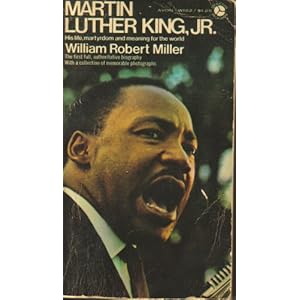
Anyways, I am taking a moment to capture the big thoughts I had while finishing "Martin Luther King Jr., His life, martyrdom and meaning for the world" by Willaim Robert Miller. Written by a pacifist, this biography offers a balanced picture of Dr. Martin King. His stellar achievements and crushing doubts are described equally faithfully.  Offered most sympathetically are Dr. King's views on pacifism. In short, push leaders to change - and change now - before the pressure cooker explodes. To the demonstrators, be generous in victory; suppress the urge for revenge. Only this way can positive change result. Here are a few quotes I am preserving,

"[On Mordecai Johnson] ...he had shown ho to harness the redemptive power of love to social issues, and through it, change had come." (p. 30)

"...but both Brightman and his associate, L. Harold DeWolf, had a permanent effect in shaping Martin's lifelong belief in a personal God and in the dignity and worth of every human person." (p. 34)

"King told the crowd that the was often advised to slow down the pace of the freedom revolution, that time would tke care of things. But time is neutral.'It can be used constructively and it can be used destructively. Unfortunately, the extremist, right-wing elements use their time more effectively."...Racism, he said, was a way of life for the vast majority of white Americans. The Poor People's Campaign had to control this ... The campaign would 'call attention to the gap between promises and fulfillment - to make the invisible visible.'" (p. 285)

"The death of Martin Luther King was not the cause of rioting but its occasion...King knew the reasons it was there, and he had pointed them out again and again. If this represented 'criminality', it was not something inborn but the direct result of continuous oppression, the denial of hope, the rejection of repeated appeals." (p. 293)

The big lessons in Dr. King's life are echoed today with the occupy demonstrations sweeping North America. The lessons learned when an oppressed people raise themselves up must not be ignored. Let's also not forget the danger to the unaware oppressors, of deliberate blindness, a dulling of the conscience, where stories of cruelty are suppressed or plainly disbelieved. It is too easy to polarize, demonize, belittle, and ignore change agents. If these people are our brothers, what does it say when we refuse to listen, to respond?

The same dynamics were repeated in the tumultuous modern history of Africa, that I read this past year. Ignorant oppressors are justifiably afraid of public demonstrations pointing out the less pretty side of society. Because the oppressed, once expressed, are on just this shade of violence. If they continue to be ignored.

I believe Dr. King's Poor People's Campaign was visionary. A nation that ignores it's weakest remains vulnerable. I believe these vulnerabilities have never been fullly addressed.

Just last week I posted my mixed feelings about the occupy demonstrators on a discussion board,

"There are shades of history that caution me from judgement. I'm wavering between admiration and annoyance.

•First of all, these kids are not the "other 99". They are a particular subset of society that for whatever reason, has time to check out from routine. I resent that they claim to represent me.

•I resent the 99 as much as I have come to resent the so-called "Moral Majority". As soon as the Religious Right DID gain power, they bankrupted the country. They also make poor losers.

•So I see a correlation between the "other 99" and the "Moral Majority". Both claim to represent an invisible and silent minority; both are more dogmatic than sensible. They should own up that they represent their own sectarian interests.

•To the protester's defence, I think the widening gap between rich and poor is a dreadful testament for a wealthy country. I studied the Human Development index published by the United Nations a few years ago. That widening gap is a pretty good darn indicator that at some point something was going to snap. It is not the richest who earn a nation's pride, it's the country's poorest. What are we doing for those most disadvantaged? There must be a rebalancing of wealth. If the wealthiest won't do it voluntarily, the government (vocal, voted majority) should intervene.

•Be cautious in accepting wild stories happening at these sit-ins. Remember that the boomers of today were hippie protesters of yesteryear. The establishement reacted badly back than. I would like my generation to show greater tolerance. We don't have to set out the dogs or tear gas, do we?"

In conclusion, even though I am doubtful that the demonstrators represent the "other 99", and skeptical of their choice of demons (Corporate America, Big Business), they do express a raging unmet need.

Leaders listen.

As a postscript, I found the story of Dr. King's emerging faith during college to be personally inspiring. It is encouraging to read how a man with highly individual and  tested beliefs could find his way in his church of choice. I'm not so sure the denominations of today have fully taken up his challenge of social responsibility. I note that even the liberal churches today are content to passively petition their governments to do more. There must be personal involvement, I would think, for active change to come about.

Monday, November 2, 2009

Civility and Humanity

I've just finished Black Like Me by John Howard Griffin. If you are unfamiliar with the book, Griffin modified his skin color to walk as a Negro in the deep south in 1959. He journalled his experience, and his deeply moving account is described in this book. What struck me is the dehumanizing effect of withholding simple civilities like a smile, a hand-shake, eating together, cautions (watch your step), and looking a man in the eye.

Withholding economic opportunities also, no matter how politely rebuffed, oppresses ambition. I once witnessed a native couple walking hand in hand, initially hopeful, making their way down a row of apartment buildings displaying vacant signs. When I exited my building a couple hours later, they were walking dejectedly, less hopeful than the start. How many times must a person face rejection - or worse, the "hate face" as described in Griffin's book - before he gives up and believes the lie? I am reminded again of Gladwell's comments on meaningful work. Griffin also describes in detail how the persecutor demeans himself by stooping to cruel behavior. To deny another his humanity is to diminish your own.

An afterword in the book describes the violent upheaval a scant decade afterwards, in the race riots of the late sixties. Mr. Griffin describes the pattern of oppression and explosion, as whites heeded rumor rather than the blacks in their on community and in the white community's reaction to a phantom threat, sparked the black communities in their midst. In the subtext is a suggestion that a lot of this could have been avoided with simple communication. In helping the black man, ask him. Provide an atmosphere where he will be honored and heard.

I can't help thinking in the general neglect, the failure to offer simple courtesy, and the polite refusal to allow a sub-group access to good housing and good jobs, that we as Canadians continue to do a disservice to our native communities. I overheard Shawn Atleo, head of the Assembly of First Nations (AFN) that it is the First Nations responsibility for instance, to develop a response to the H1N1 virus. I think he is talking about upending the paternalistic response to "the problem" (As Griffin speaks of in his book), and allowing this community to speak for itself and take care of itself.

__________________

On another note, I stumbled across this article while investigating online acquisition of queue. Guess what? Other people took it before me. At queue.ca, a Canadian IT company, they speak about Customer Relation Management (CRM). Like most things, it's not the tool that makes the company, but the application. Guess what? Just like community interactions, a company will also be much more successful if it listens to it's customers, and is willing to make changes to their process in order to make it better.

The technical issues with CRM are not unlike those of any software development project. First, objectives and specifications must be well defined and documented. Tools and technology must be selected based on relevant criteria (features, cost, etc…). Implementation milestones are then set according to business timelines and availability of resources. A significant testing phase is recommended to ensure functionality, so problems can be corrected on schedule. Final delivery of the application should also be accompanied by a maintenance plan for regular housekeeping issues (backups, synchronization with remote locations, database maintenance, etc…). E-CRM is not EASY by Alex Lee, 2002 http://www.queue.ca/publications.aspx

Saturday, September 26, 2009

Fighting Crime

It's been a crazy-busy week. Work absorbed, which I think I've talked enough about now. But also I've been busy with condo board stuff. Sharlene and I both attended the Clareview Crime Council meeting to learn more about what can be done about crime in our neighbourhood.

Sharlene and I attended because there is a fair bit of petty crime activity in our back parking lot. Cars are broken in to or stolen. Shady deals are passed between cars with darkened windows. So we went to this session to learn more about what is available. Unbeknownst to us, the meeting was also a recruitment drive. We're both signed up. *sigh*. Ah, well. If it proves too much, I can always bow out.

But wow, so much we learned in that hour and a half. There's all sorts of crime prevention associations out there. There's all kinds of resources available, too. I got a phone number for "report a drug house". We can get a "safety audit" done for our property. There's a Coalition of Crime Councils. I met social worker who works in our neighbourhood. There's Safe Streets and Neighbourhood Empowerment Teams and Safe Edmonton (this looks good).

There's an expert on Neighbourhood Empowerment, Jim Diers who will be coming to town to speak on November 17, 2009. He has a book and now I am eager to hear from him in person. I bet a lot of what he talks about ties in to my ponderings on how we can humanize intake experiences.

It all comes down to people, doesn't it? Why haven't I heard of all these councils, resources and associations? Is it because I had bought in to the apathy and assumed there is nothing that can be done?

By the way, as I browsed the internet to confirm links above, I found InformAlberta.ca. It appears to be a self managed site to link all sorts of services in a mega-database The Safe Streets link was bad. The "contact us" form was markedly worse, consisting of over a hundred fields to review, two tabs, and obscure instructions...in red. God help me if I filled out the inquiry wrong. Will the internet police be after me soon?

Oh, and I should mention that the Clareview Crime Council provided FOOD and COFFEE. Coffee was compliments of our local Mac's owner, who recognized me and greeted me as I came in. It is heartening that he is so involved in our community.

Friday, August 14, 2009

People Flock

I'm halfway through a book that is a collection of studies on how people react to failed prophecy; the book is called "Expecting Armageddon, Essential Readings in Failed Prophecy" edited by Jon R. Stone.

Article after article describes how a person can accept the most outrageous explanation, even when all evidence points to the contrary. One of the factors that helps a person accept unreasonable beliefs, is that he is surrounded others who believe it too. You might have heard of "groupthink". (Do follow this video link; it is hilarious)

It seems to me that we have some base instincts that drive us to follow the crowd. This would be a useful evolutionary tactic for creatures who live in packs; including humans. Once I identify with my "crowd", I will fiercly defend it. In return, I get protection by that "crowd". This ability to create groups with strong identities, even to the point of outrageous reason, may be called "granfalloons". What a grand word.

Besides the unreasonableness of some of these groups, I think another great hazard is the suppression of individuality. We naturally give up some of our rights to the crowd, in the interests of mutual safety. I suggest, though, that if the group insists in it's own identity being protected at the cost of individual, it has gone too far.

We see this happen in some groups (think high school) where those who are too different, and the dissenters, are shunned, mocked, or worse.

In Western society, where we worship individualism and tend to dismiss the power of groups over us, I think we underestimate the terrible power of expulsion from a group. The sense of loneliness and abandonment is severe.

What is the balance? Individuality must be protected, but extreme individuality is anarchy. The interests of the group are valuable, but a group that insists that it's own values and maintained at the sacrifice of the individual, suppresses.

The author who expressed this struggle best that I've seen, is Jean Vanier and his book Becoming Human. Jean Vanier is the founder of L'Arche, where people are invited to partner and live with people with mental handicaps, in order to get in touch with the essence of humanness. The commitment of these pairings is intense. Vanier's vision of a healthy group is one with soft borders, that has a shared vision of inclusion rather than exclusion. Healthy group, healthy individuals.

Tuesday, February 17, 2009

A New Reason to Visit Heaven

For the second night I am haunted by the pictures in that Life magazine. I dreamed of the girl carrying dozens of loaves of bread. I dream of her and the boy who confronted his violent father. The eight year old boy called the cops on his dad when his dad threatened his mom with a knife. In the photo the boy hollers in his subdued father's face, "I hate you. Don't you come to my home no more".

In the dream, that boy smiles at me. I want to talk to him in the baddest way. Did he grow up strong and good? And the girl. Was she able to skirt bitterness and the weariness, and find joy in life?

So these two kids are added to my list of people I want to talk to in heaven. There's Moses, a humble man who walked his people out of slavery and along the way wangled a friendship from God. And Florence Nightingale who patiently changed her world forever with application of sanitation in the hospitals and respect for the common soldier.

There's a quality in survivors that I deeply connect with. Researchers are finally tracking down that elusive quality. It has something to do with resiliency. An ability to look at a blow in a different way; to see opportunities; to determine a different future.

Monday, January 26, 2009

Word Power

My daughter asked me what I was writing during church. She was astute enough to know that it was too productive to be sermon notes. So I told her. I had written that I am too quick to "write people off". She agreed with me, much to my embarrassment. She even gave an example where I spoke frankly about a nutty neighbour, months before she became a member of the condominium board. I still do privately think of her as nutty, but it does turn out she also is an outstanding parking coordinator, resolving several disputes in a very short time. We'd had a cold snap, you see, and everyone hustled to find their spot to plug in the car. More than one resident thought they had the same spot. Our newest board member sorted them out, literally within days, nipping in the bud a whole lot of ill feeling. I grudgingly agreed with my daughter that I had been too quick in my assessment.

This morning I woke up thinking of the power of words, especially written words. I'm marking history with my own perspective and flavor. Mine will hold sway simply because it's recorded. Private thoughts influence us for a time. Privately shared words influence our neighbours, and often have lasting effects we did not intend (the power of gossip). But the written word, oh the power! I am reminded days, weeks, or years later how I saw my world. Written words are more definite, like gospel. I can weave for myself new realities that will be harder to refute. Written word acts like truth. I have to remember, though, that it is not. Truth stands on it's own.

So this is what I wrote during the sermon yesterday, completely unrelated to the pastor's topic. He was not that boring, really. He spoke convincingly of how special interest groups impose on Jesus their own idea of what a Messiah would look like. They are all wrong.

Back to those private notes. I write off people too often and too fast. I must speak up sooner, articulate the offence, and forgive quickly.

Why do I do that? It is a habit from childhood, when my "elders" or the "dominant" or the "other sex" in the room declared themselves the experts and proceeded to work on whatever needed fixing. I had the answer, but I was re-inforced, often, that my opinion did not count. I quickly figured out that it was more efficient to say nothing. The better lesson was to wait for the failure. Then I would step in with the fix. People learn faster from their failures than from preaching anyways.

But I think also I've done a disservice to my colleagues. I could have potentially saved them from embarrassment and a whole bunch of wasted time. I could have lifted them up from the first and helped them look better.

So, now, the power of writing this down takes effect. I cannot pretend I did not get this lesson this week. Let's see how well I put it in to practice.
The photo I borrow from Concurring Opinions, a general-interest legal blog operated by Concurring Opinions LLC, a Pennsylvania Limited Liability Corporation.

Thursday, January 1, 2009

A Case of Excessive Courtesy

A reader of my blog asked me how I manage to accomplish so much. I gave her a list of reasons why I've ended up the way I am. Not all of the reasons or noble or pretty. There has to be an element of obsessiveness for me to do all that I do. I do so many things well, and I do so much, something has just got to give. My hubby would cheerfully give you a long list of my defects. Perhaps the quirkiest is my inability to keep track of simple things. I lose keys, credit cards, change purse, pens, lip balm, and mitts. Hubby says I'd lose my head if it wasn't screwed on tight.

I got caught out yesterday in a moment of absent-mindedness. The incident and the recovery is an example I think, of the Canadian habit of excessive courtesy. I have a theory, too, on why we do it.

I plan to go to the YMCA to work out after we are let out early on New Year's Eve. I've had an exciting week of physical activity, shifting files, and I am eager to keep the momentum going. I hop over from my secondary office to my primary to pick up my gym bag. The YMCA is right across the street from there. I open up the bag, and there are no gym shoes. Drat. I'd left them at home. Anyways, I go for my swim. Still burning with excess desire, I decide to finish off with twenty minutes on the recumbent cycle. I've cycled at home in my socks before. No harm, right? Did I mention I am wearing thick, day-glo orange socks?


I love thick socks. They cured me of a heel spur years ago, and I won't give them up. These socks are old and chunky, losing their elasticity. They were a poor choice this morning, as they bunched up in my shoes as I shifted files. I'd ended up taking off my shoes on the job so I wouldn't be walking on bunched-up cotton. Perhaps this old chunky pair are due for the dumpster.

Anyways, I am padding through the exercise room in my day-glo chunky old cotton socks. I reach the recumbent cycle at the end of the row, and I am pounced upon by one of the staff. "Excuse me", as he glances nervously at my feet, "Do you have gym shoes?"

I am mortified.

"I am so sorry. I thought I had them with me but I don't. Would it be all right if I went on the machine anyways?"

We jumble our apologies and our reasons together in a rush,

"Maybe this once."
"I won't forget my shoes again."
"You can't go over to the weight area."
"Of course."
"And the treadmill. I hate to think what would happen if you had an accident on the treadmill."
"I won't be going on the treadmill today."
"I'd hate to be responsible...just this once."
"I'm sorry to put you through this. I will be sure to bring my shoes from now on."
We agree I can have my twenty minutes on the cycle machine.
There was such a complex interaction of empathy and a desire to please in that short exchange. Neither of us wanted to dissapoint. He had his duty towards the safety of the members, of course. He had to confront me, as unpleasant as that might be. I wanted to avoid embarrassment and the extra chore of coming back another day through the traffic and storms. It got me to thinking how many times that week I'd heard strangers reflexively apologizing for the smallest things.

It seems to me the apology index went up as soon as our weather became brutal. Edmonton has finally been hit with cold and snow. This week also I finished "The Seven Habits of Highly Effective People" by Dr. Stephen Covey. It took me a year to finish the book because I got stuck on habit three. The third habit is to do those things you know would make the biggest impact on your life. Covey askes, pointedly, why we don't do them? Because it is easier to ignore the big things! My big thing is exercise. Surprise. Anyways, I made it past habit three and the rest of the book was a cinch.

Covey speaks of our need to build each other's Emotional Quotient. If someone's EQ is low, it doesn't matter how reasonable our request. Their reserves are depleted and they are in no frame of mind to grant requests. Covey impresses the requirement to "seek to understand" before we strive to be understood. This is habit five.

It seems to me a batch of tough weather takes a toll on us all. There's the planning of the trip and the coordination of errands. No-one wants to take the trip twice. There's the dressing and the bracing for the hit of frigid air. There's sweeping and shovelling and skidding and caution. It's like the entire community's EQ takes a dip with the thermometer.

It seems that in the midst of adversity, we make a community decision to be nice. To show extra courtesy. To be kind and polite, and if necessary, apologize where no apology is needed. Because we all know deep down that we need the boost.

Like a community of winter birds, huddling to stay warm through the dark nights, we help get through the cold together.

So that's my theory. Canadians are extra nice because we never know when we might need a boost. It's like we pad our guts with an extra reserve of warmth. By experience we know we are all in this together. The happier you are, the better off I am too.
The blogger, ACPL Kids hosts the picture above, "New Socks" by Bob Shea.

Friday, December 19, 2008

Creepy Santa

It's tough to keep the Christmas spirit going. I forge ahead by feeding myself with sights, sounds and smells. This year I made a low-fat version of Christmas cake. All right, it's still heavy and rich - there's no escaping the candied fruits and nuts - but what I really wanted was my house filled with rich, warm smells. I also splurged on a real tree this year. Also for the smells. A fifteen dollar tree from Superstore, just a tad lopsided. He sits on one of my side tables, decked out in three seasons of silver globes, picked up at after-season sales.

A sight I could have done without is robot Santa at Wal-mart.

http://www.youtube.com/watch?v=xjRt3dC5rVo

He sent me automatic greetings every few seconds, as I stood at the door, bundled up with my purchases, waiting for hubby to pick me up. Anyways, there's this robot santa standing above the seasonal racks. On schedule, he makes some spastic moves and mumbles something Christmas-ey. Thankfully, he is drowned out by the buzz and clatter of the shoppers. But we had those few creepy moments together as I waited for my ride.

Whatever was Walmart thinking?

I watched a documentary on Mall Santas last night, very well done. Here's a fine review. The director, Mike Sheerin , gives us to peek in to the lives of three Mall Santas who take their job very seriously. There's an exchange of kindness; all three men get something special from the lives they touch. A surprising flip side is the barrenness of their personal lives. When Christmas is all over, Santa is forgotten. I'm of a mind to pass on my thanks to these heroes of the human touch....on Boxing Day.

Meeting Santa is all about humanness and warmth. A benevolent stranger cares about me and wants to know how I am doing, what I most wish for. You can't get that touch from a machine. I'm all for technology when it helps. Sure, automate the check-out experience. I'd be happy to do that chore myself. But Santa can't be automated. He's a living, breathing symbol of care.

Wednesday, November 19, 2008

Deep thoughts under a lurking migraine

After listening to "The Last Lecture"...several times...I bought the book. I bought two of them. One is for me, and one for the lucky employee who impresses me this year. Anyways, having finished with Mercator, I picked the book up, and polished it off in two bus trips and some late night reading. He repeats much of what he said on screen, plus he shares more about his family. The written word is handy for that. You can share deep feelings without blubbering all over the paper (or screen).

So it got me to thinking what I would share in my own "last lecture". It would most definitely start with "do not be afraid", and would include things about boundaries (respecting yourself) and barriers (removing them), about hummaness and inclusion, about believing and trusting yourself, about decency. Find your community, and work hard to make it yours. How to measure the quality of the information you find. How to measure the quality of your own beliefs, and to question. Be a leader worth following, and see how the world changes around you. Why it is worthwhile to fight for a better world.

P.S. I thought of two more. Integrity, the big lesson from my father, and self-discipline. How to get it and keep it and demolish the whole guilt cycle.

Thursday, November 13, 2008

Something New - Youth Games

A local organization is promoting an "Edmonton Urban Games", possibly for 2010, that will feature at-risk youth participating in hip-hop, beatboxing (what is beatboxing? Oh. It's music. I thought it involved beating on each other) graffiti, and skateboarding.

Here's another great group, working at breaking down the barriers, and re-integrating some of our disenfranchised back in to the community.

The organization is Youth Restorative Action Project (YRAP), and is peer-run. Think about it. Committess of teens telling teens how to straighten out.

Saturday, November 8, 2008

The seven fruits of the soul

My theological meanderings have brought me to Judaism. If I am to understand the foundation of my faith, I must understand where it came from. And Christianity is definitely born out of it's Jewish roots. The biblical condemnation of the Pharisees and centuries of anti-Semitism, I fear, have kept Christians from any deep look at our similarities.
That's where we get peace from, isn't it, not from highlighting our differences, but how we are fundamentally the same?

I've been transported by new ideas in the way that a Jewish scholar may approach the Bible. And don't think that all scholars approach the bible the same way. A treasure from the Jewish school, I think, is that reflection, questioning, and doubt are part of the curriculum.

So, anyways, I've been introduced to the concept of the seven fruits of the soul. In Chaddism, wheat, barley, grapes, figs, pomegranates, olives and dates have allegorical meanings beyond the plain reading of the text. Each represents a quality of man, specifically transcendence, vitality, joy, awareness, action, struggle and tranquility. The Jewish holiday of Yom Habikkurim celebrates rebirth in the spring and the first fruits of the harvest, including these seven traditional "fruits" of Isreal. For Christians, we would recognize this in the Old Testament as the feast of "first fruits".
What relevance does that have for us today? Well, in reflecting on our seven characteristics or needs, we might see where we are out of balance, or where one over-arching characteristic or need has overtaken our life. It might help, on self, reflection, to re-introduce balance in our lives.


Sunday, October 12, 2008

It just makes the world a little less cruel...

The chicadees were waiting for me this morning. They were close enough for me to see their plump grey forms hopping up the bush. It pays to be reliable, especially when little creatures are depending on you.

I got a follow-up e-mail from someone else interested in Homeless Connect, and she twigged me to a YouTube clip on the San Franciso campaign. http://www.youtube.com/watch?v=M1-K0-GC7jM It looks as wonderful as it sounds. The line that really stood out for me on the video was from a volunteer who said, "It just makes the world a little less cruel." Another volunteer noted that these are the same people we pass on the street every day without acknowledging, yet in the connect atmosphere they are "just like everyone else." Isn't that what it is all about, to bring humanity in to every interaction?

On a separate note, I just finished another delightful novel from Alexander McCall Smith. He's the only author whose books I can't wait to come to paperback. I'm beginning to collect an impressive series of hard bound books about the "No. 1 Ladies' Detective Agency", set in Botswana. But this man does a lot more than write delightful detective novels. He is also an expert in the field of bioethics, serving on many national and international bodies. A BBC biography writes of McCall Smith, "If his day job presents its own philosophical complexities and dilemmas, McCall Smith's writing offers an escape to a place that celebrates moral certainty, warmth and compassion. The author considers it "legitimate to write about virtue" and The Detective Agency series, in particular, shows "qualities that are found all over Botswana. People don't go in for distance and insincerity"."

Legitimate to write about virtue. What a delightful turn of phrase. Is it not also legitimate to campaign for virtue and decency, even in a jaded world?
___________________
Update from Elise, on Facebook: "Anyways, I heard really good things from my co-workers about that event (Homeless Connect). They all thought it was very successful. The event expected 1000 people but over 1500 showed up! "

Friday, October 10, 2008

A Tipping Point to Peace

On September 24, the Edmonton Journal told a good-news story of city counsellor who helped turn around escalating teen violence in the community of Mill Woods, "Road to justice in Mill Woods takes a splendid turn". City counsellor Amarjeet Sohi brought together the parents and the police to talk and come up with solutions. Most impressive is how the escalating violence has been brought to an abrupt end, and struggling parents were brought together for assistance and mutual help.


I think this is an impressive example of, not only of great leadership on the part of Counsellor Sohi, but of the principles of the tipping point as described in Gladwell's book. Not only was an epidemic of violence stopped in it's tracks, but a new positive epidemic of support and helps was generated for a community.


I think the incident also points out that we can't objectify violent teens as a problem of "those people". The problem could erupt anywhere, in our own households, if the conditions are there. Parents everywhere take note, and get help if you need it.


We mustn't justify violence as a natural progression in a growing, struggling city. Find the root of the problem and be as bold as Sohi to take action.

Friday, September 26, 2008

Aunties and Grandmas

I remember when I fell in love...with my granddaughter. The grass became greener, the sky bluer. Everything was right in the world. I became a better person the day Naomi was born. I had a little person to impress.

There are great advantages to being an auntie or a grandma. We get to choose our moments to shine. There are great big rest breaks in between. We don't have to be the disciplinarian. And there isn't that niggling mother-daughter struggle for supremacy. Now, that doesn't mean I haven't been on my best behavior. After all, I have a reputation to build. Grandma reads stories. Grandma bakes cookies. Grandma always hears me; she listens.

But in our North American culture at least, extended family plays a subordinate role. If a parent deems us a danger, we're out of it. Out. There are "grandparent's rights" groups, of course. But legally and socially, custody and raising primarily rests with the parents. Not that this is wrong. But it makes me very, very respectful. Mom and dad have a huge responsibility after all. I must not ride roughshod over their decisions. After all, I am deeply in love.

Saturday, September 20, 2008

Nurturing and Naomi

It hit me the other day. Naomi is growing away from me, blossoming, growing. Just like her mom did over twenty-five years ago. I see her animated face, her expressions, her joys, her friendships, her occupations. It is so individualistic, so her. She is showing the signs of the fresh young woman she will be. She is blossoming. It is natural what is happening, her growing apart. Even when she tells me how her and her mom "nearly forgot your birthday" and worked 'till "one o'clock!" to put together a pretty gift basket. From Naomi I get a home made card crusted with stickers, declaring her love. I love her too, painfully so.


I see her bright future. More and more her network of friends and mentors will take over, and I will recede as one of the centres of her life to a friendly morning star. I will always be in her constellation, always watching and cheering her on, but I will no longer be the centre.

The generations march on, and I am helpless to slow the progress. My joy will have to be to watch and marvel.

Monday, September 1, 2008

Civilization

Civilization, decency is fragile. It requires each of us to be alert, diligent to keep our humanness.

That's my conclusion after thinking deeply on Romeo Dallaire's message when he came to talk to us all (on June 20, 2008?). Here's another book for me to try,

"James Orbinski's An Imperfect Offering: Humanitarian Action in the Twenty-First Century. Orbinski, the Canadian physician who served for more than a decade with Medecins Sans Frontieres (MSF), took his darkest journey into the abyss of human suffering during the Rwandan genocide, when hundreds of victims overwhelmed his Kigali clinic. It was there, as he desperately sought to staunch the wounds of a woman raped and then mutilated in the most unspeakable fashion, that he came closest to despair. It was this patient who, holding his arm, said "ummera - sha" -- "courage, my friend" -- and sent him on to help other patients while she awaited death. Her quiet, selfless compassion guided him through many more horrific experiences." - Salt Spring News http://www.saltspringnews.com/index.php?name=News&catid=&topic=6&allstories=1